Goat milk cream could be a natural product that comes from goat milk, however, unless you've got a milk cream separator a number of that cream goes to be pretty troublesome to get rid of.
Now that doesn't mean that you just cannot get the bulk of the cream of the goat milk, it simply implies that some are getting to be left behind.
The only downside is you may have to be compelled to either freeze the cream till you've got enough for your formula otherwise you are getting to have to be compelled to purchase a cream separator at the shop to supplement what comes off the goat milk.
How To Separate Goat Milk Thick Cream
As mentioned higher than, the best thanks to separate the cream from the goat milk is to use either a manual or electric cream separator.
These have come back a protracted manner in recent years and a tabletop version appropriate for a smaller quantity of milk is currently promptly accessible.
A cream centrifuge is largely a centrifugal device that separates the cream from the milk therefore you finish up with cream and milk.
There are each all-metal ones and ones that are made from plastic.
While the plastic ones are cheaper, my recommendation is to settle on one that's all metal therefore it lasts for years to come back.
Of course, must you decide to not pay the cash to shop for a cream separator, there's different to get rid of the cream from the goat milk.
Simply enable the goat milk to take a seat within the white goods nightlong or a minimum of between the morning and evening milking, then use a metal spoon to scoop off the maximum amount of the cream as you'll.
The cream will rise to the highest of the jar because the goat milk cools.
If you set your goat milk in an exceedingly clear glass instrumentality, it's simple to differentiate the cream from the goat milk as a result of the cream goes to make a thick darker white layer on the terribly prime of the goat milk.
When you take away the cream with a spoon it will appear reasonably thick and gloppy.
This is traditional.
Now by removing it employing a spoon, you're getting to miss some and additionally find yourself with a bit of milk within the cream.
Tips For Separating Thick Cream From Goat Milk
I like to relax my goat milk in pint canning jars crammed not quite 1/2 full once I pasteurize the goat milk.
While smaller amounts of milk mean there's a diluent layer of cream that forms on prime, I want this can be what works best on my behalf of me.
Now, if you retain your milk within the white goods for terribly long, or maybe freeze it, a thicker layer of cream would possibly type on prime of the goat milk, particularly if you probably did not savvy all scraped off with a spoon throughout your initial strive.
Just check the goat milk before you employ it and scrap off any that continues to be.
If you employ a cream separator for goat milk, however, this could not happen because the machine should take away all of the creams.
How To Use Thick Cream
There are several uses for cream.
Recipes like frozen desserts incorporate a combination of goat milk and cream.
Homemade topping needs the employment of cream.
Another fashionable use for cream is this goat milk butter formula.
Of course, there are different uses for cream likewise, and albeit, I favor taking away the cream from our goat milk before drinking it just because I don't just like the feel of the clod of cream once I drink it.
For people who favor laying aside their own cream and not using any factory-made cream in the least in their recipes, a simple thanks to trying this is to freeze the cream mistreatment identical technique wont to freeze goat milk.
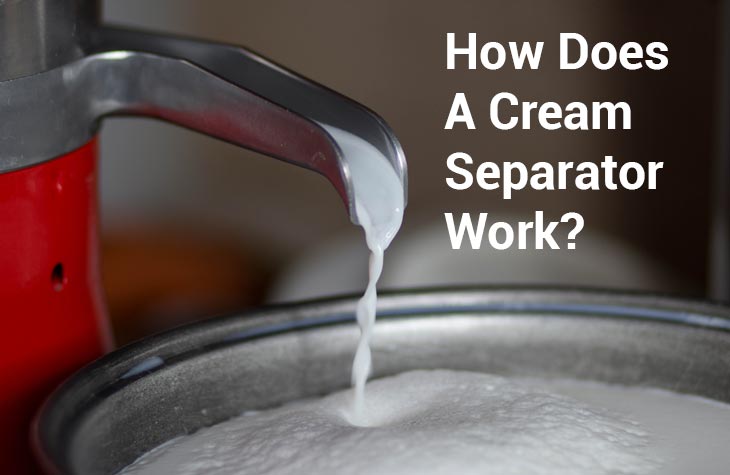
Making dairy products by hand is too tough. So, if you manage a dairy farm, you must grasp the significance of each and every machine that is employed in the dairy industry. We will discuss the cream separator in this post, which is used to separate the cream from the milk.
With the advent of technology, any task can now be completed with the assistance of machines. If you want to start a dairy business, you must first grasp the importance of each machine that is utilized in the industry. Dairy equipment must be used with care in order to remain in good working order for a long time. Dairy machines contain a variety of equipment, including:
Cream Separators
Milk Pasteurizer
Butter churner
So, in this essay, we will go through the cream separator in great detail. If you want to start a dairy business, you should read this article attentively. First and foremost, you must learn how to use a milk cream separator.
What is a milk cream separator?
The milk cream separator is the most important piece of dairy equipment for separating milk from the cream. There are two types of separators on the market: manual and electric cream separators. Small business owners typically employ manual cream separators, but electric cream separators are used to create enough or too much cream from milk. The following are the main components of a separator:
Casing
Milk receiving tank
Electric Motor
Drum
Cream and skim milk receiver
The float chamber
To get the greatest quality product, you must verify all of the parts ahead of time. Let’s try to know the principles of the cream separators.
Principle of cream separators
Separators come in a variety of materials, productivity, and capacity, as we mentioned in the previous paragraph. Furthermore, you have the option of using a manual or electric cream separator, all of which operate similarly. These separate milk from cream, with the help of a drum and plates found in a milk separator. Separation of contaminants is also part of the separation process, which ensures that you get a high-quality product or cream.
The process of Separating Milk
If you’re using an electric cream separator, you’ll need to turn on the switch first and then wait for the engine to start correctly.
After that, pour roughly 1 liter of water into the cream separator before pouring the milk in.
After that, you must boil the milk at a high temperature for at least 2–3 minutes and repeat the process.
Separates the cream from the milk and stores it in the utensil at the end.
In this article, we will discuss what a cream separator is, its purpose, and how it works. We will also go over the best cream separator machines on the market.
Scroll down to learn about each aspect in detail.
What Is a Cream Separator?
A cream separator is a machine that removes and separates the cream from whole cream.
Modern cream separators are automated and have the capability to produce milk of any fat content.
At a milk production plant, the cream is separated from the milk via a process called centrifugation. The milk is placed in a large bowl and rotated at a high speed until the cream is eliminated. This is what exactly a cream separator does.
A milk separator also acts as a clarifier because all the unnecessary particles that are heavier than skim milk (e.g. bacteria, sediment, somatic cells) are collected in pockets outside the separator.
Did you know that grocery store milk is homogenized? This means you cannot remove the cream from it. In the production process of milk, its fat globules are broken down to ensure that the particles amalgamate with the milk and don’t float on top.
But if you receive milk straight from a cow, skimming the cream is a hassle. It requires patience and dedication. How do you make cream from milk? A cream separator is the most convenient and reliable tool to skim cream.
The milk moves through the conical disks with a force equivalent to thousands of times the gravitational force.
Since the fat globules are the lighter part of the milk, they move to the drum’s heart, while the heavier skim milk goes to the sides as it separates from the fat. The whole process is dubbed cream-skimming.
Why Use a Cream Separator?
How do you separate cream from milk? Using a cream separator based on the principle of centrifugal force is the modern way to make cream from milk. It is a fantastic device that removes the cream from cow/goat/camel/sheep/etc. milk. How is cream made from a cream separator? Operating a milk separator is easy. You do not need any professional training.
Once you read the manual and understand the different buttons as well as their functions, you are ready to separate the milk.
A cream separator is a preferred choice if you are producing dairy milk and skim milk in bulk. The different components of a cream separator are durable and straightforward to clean.
How Does a Centrifugal Separator Work?
As discussed earlier, a centrifugal milk separator operates on the power of centrifugal force. Such a separator is popularly known as a centrifugal separator.
Now, let’s understand how it works. Centrifugal force is generated whenever a vessel that is filled with liquid (e.g. milk) is spun.
This is why a centrifugal separator is also called a disc bowl separator. The field creates centrifugal acceptation, and this isn’t as steady as gravity.
A centrifugal milk separator has baffle inserts in the form of conical discs. This increases the area of sedimentation.
When whole milk is inside the bowl, the centrifugal force runs through the baffle inserts, and the heavier part (e.g. cream) is separated. After the process, the milk and cream flow out of different spouts.
10 Best Cream Separator Machines on the Market
Are you considering investing in a cream separator machine but are baffled by the number of options on the market? Do not worry. In this article, we have rounded up the top-selling cream separators on the market.
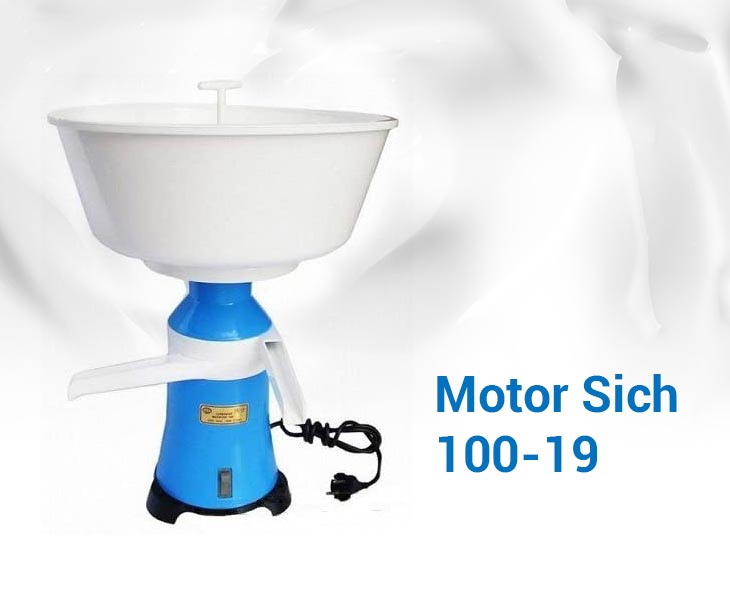
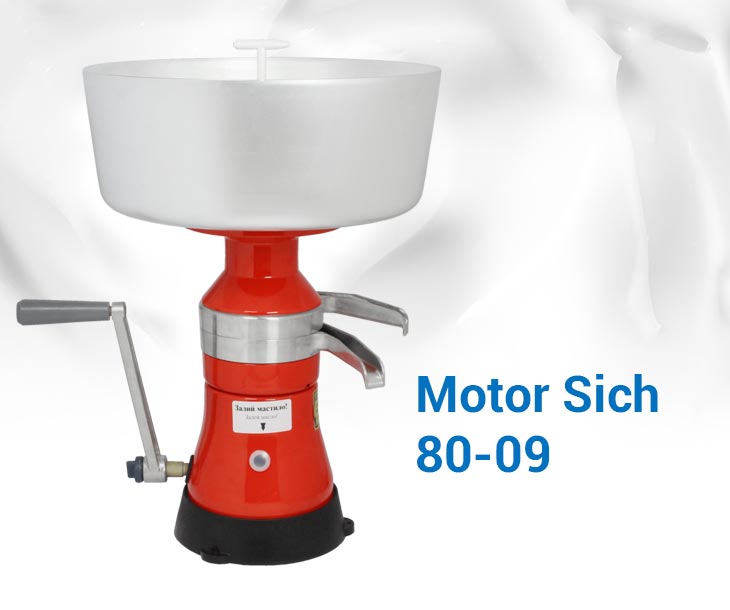
Motor Sich has manufactured an electric cream separator made of food-grade polycarbonate, thus ensuring healthy output every time.
The Motor Sich electric milk separator can skim milk from cows, goats, sheep, camels, and more. It has a capacity of 100 liters per hour. The Ukrainian motor comes with brushes that make it ideal for commercial use.
The only flaw we could find with this machine is that the polycarbonate structure makes it slightly heavier.
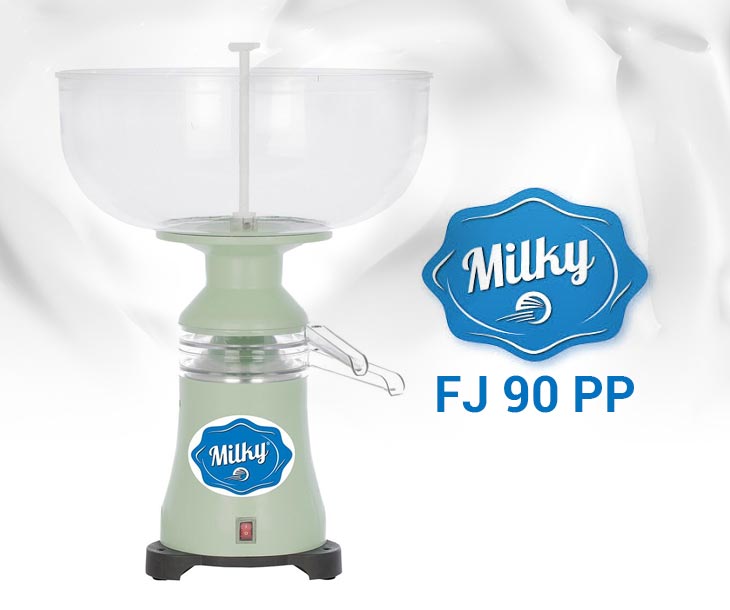
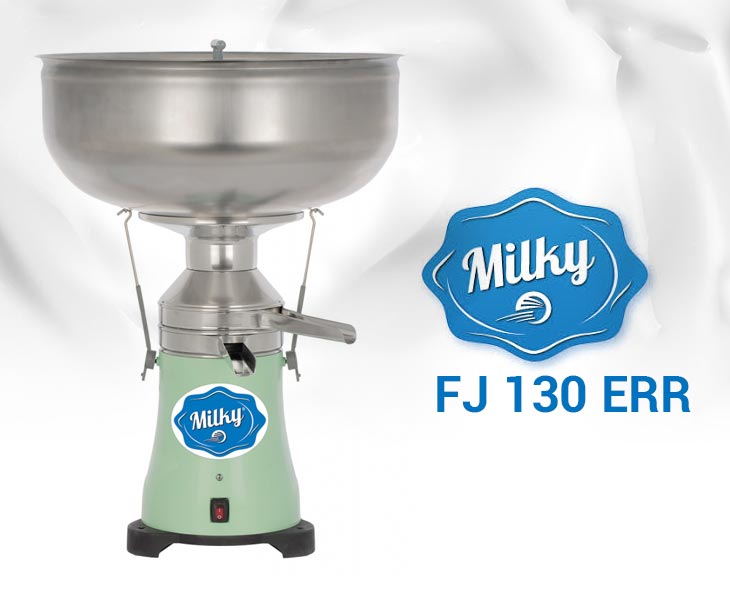
Your search for the best cream separator that is most efficient and easy-to-operate will end with the Milky FJ 90 PP. It gives an output of 80-100 liters/hour. The Milky FJ 90 PP mortar is durable, and the parts don’t rust with time. The components are made out of food-grade materials.
With an hourly output of 34 gallons per hour, this cream separator is insane. It has anodized aluminum disks for super durability. It is best suited for commercial use, separating anodized aluminum disks cream, sour cream, and low-fat milk. This machine is easier to operate, and the parts can be quickly assembled and disassembled.
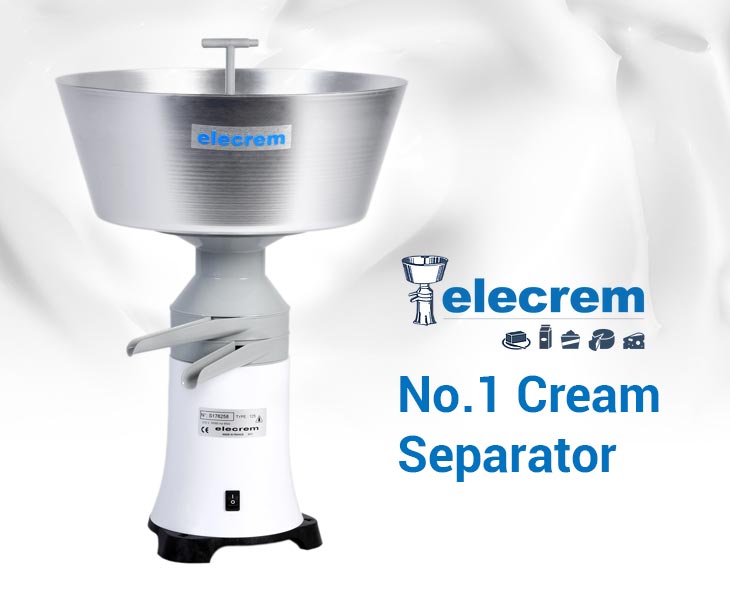
#5 Elecrem No.1 Cream Separator
The only flaw we could find with this machine is that the polycarbonate structure makes it slightly heavier.
Elecrem No.1 is an electric cream separator capable of generating tremendous speed to provide a good output compared to other models on the market. It ensures a thorough separation of cream and milk, delivering the finest-quality milk for consumption.
The machine can separate 125L of milk per hour and comes with a 10L capacity reservoir tank. It requires a voltage converter for use in the USA and Canada.
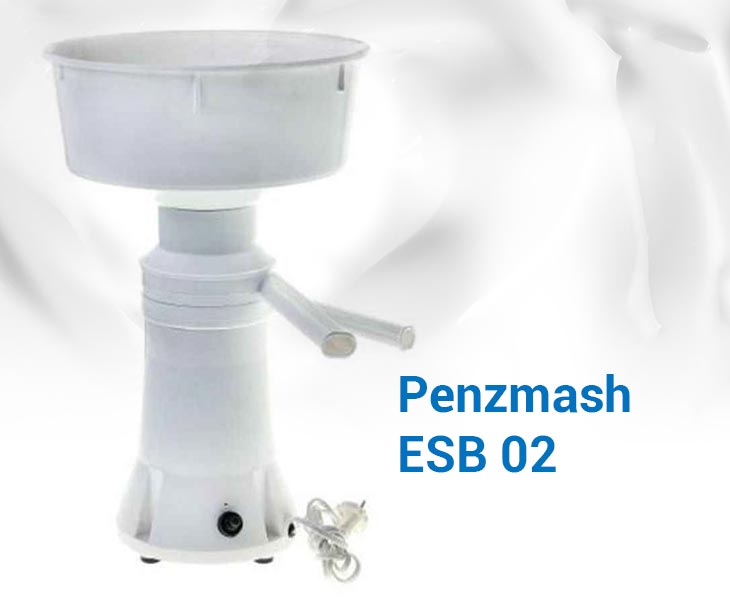
#6 Penzmash ESB 02
If you are searching for an affordable cream separator that skims 50 liters of milk per hour, the Penzmesh Cream Separator is a good choice. It has a durable construction. You do not need to worry about wear and tear.
This machine is straightforward to use. You will master its basic functionality in no time.
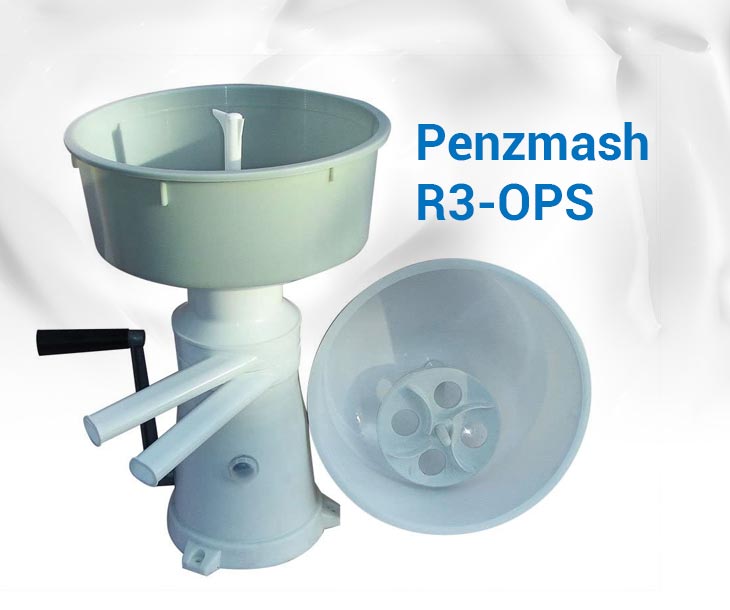
With 0.05% max fat in skimmed milk, this Aluminum alloy provides 80 – 100 liters/hour of output per hour. This hand-operated Motor Sich milk separator is preferred for regions with electricity issues. T8. Penzmash R3-OPS. Using this manually operated machine, you can make sour cream, and low-fat milk at home. This product is a perfect blend of quality and affordability.
The only drawback is that you will have to rotate the bowl by hand, so be ready to flex your muscles.
#8 Penzmash R3-OPS
This cream separator made with a maximum of 0.05% fat is suitable for both domestic and commercial use. Made of high-quality materials (aluminum alloy), this machine provides great durability.
From the installation to the usage, this milk separator offers real convenience.
The machine stays stable during operation. However, it is not the lightest milk separator on the market.
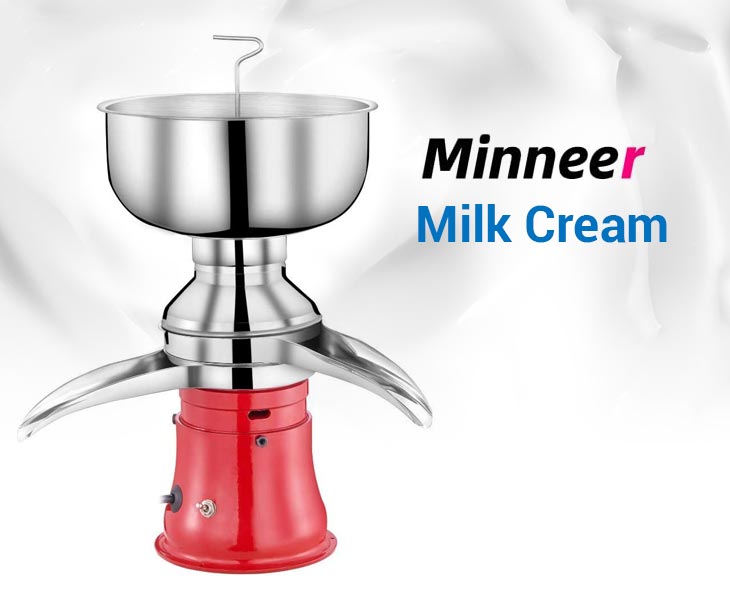
#9 Minneer Milk Cream
This stainless cream separator is versatile and convenient to use. The machine is fully automatic. Just switch it on, and it will start the cream separation with no manual effort.
It can skim 21 gallons of milk per hour. The various parts of this machine are slightly difficult to clean.
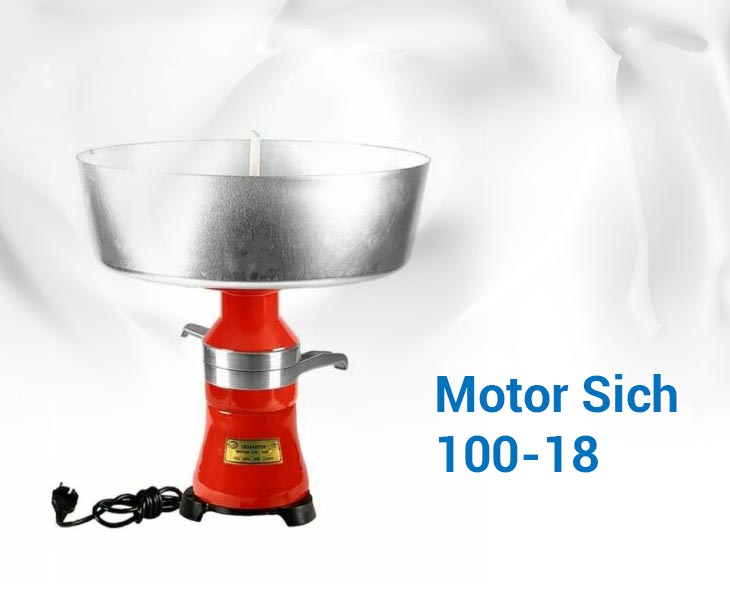
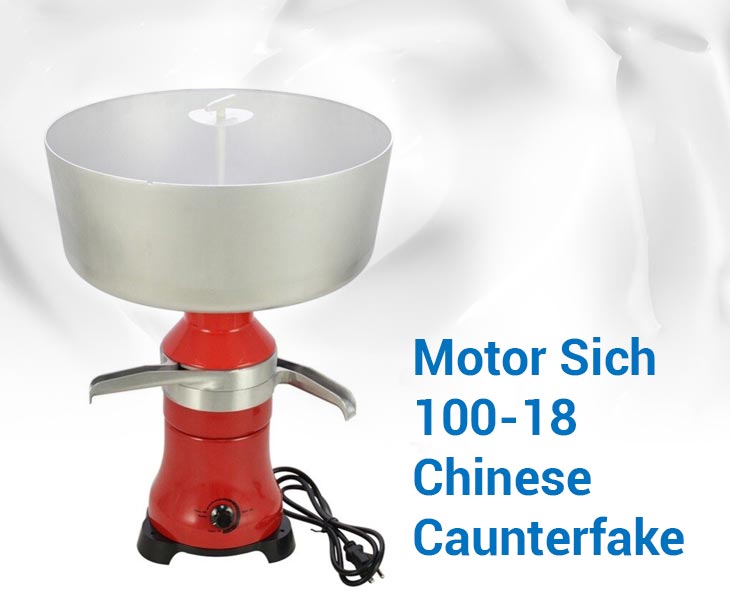
#10 Motor Sich 100-18 Chinese Caunterfake
Last on the list is the Motor Sich 100-18 cream separator.
It has a strong construction, as the parts of this cream separator machine are made out of good quality materials for excellent durability. So, it can handle rough and tough use. The installation process is a walk in the park (5-10 minutes).
Wrapping Up
Before making a purchase, it is of paramount importance to research the cream separator’s manufacturer and its market credibility. There are endless options for cream separators on Craigslist, but you should opt for one that is made of high-quality, food-grade material. It must be light in weight and therefore convenient to transport from one location to another.
One of the best qualities of milk is that one can turn it into numerous other products through processing. It’s a great opportunity for small dairy farms to offer their customers a wider choice of options after initially only producing milk. Fortunately, you don’t need a whole milk processing factory to offer different dairy goods. In this article, you will find out everything you need to know about small-scale dairy processing.
Small-Scale Milk Processing
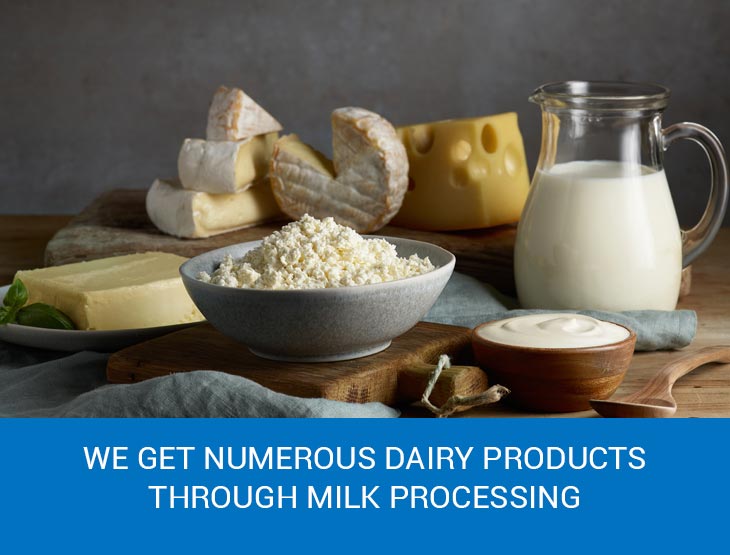
You can get numerous dairy products through milk processing:
Cream
Butter
Pasteurized milk
Yogurt
Cheese
Ice cream
Fluid milk
Buttermilk
And other products
Almost every small farm processes milk to make it pasteurized because it’s forbidden to sell raw milk in most countries. To achieve that, milk is heated in pasteurizers — special devices for pasteurization — and then cooled down. This process destroys disease-causing microorganisms to make milk safer. Also, pasteurization increases the shelf life of dairy products. That’s why most governments demand that both large manufacturers and small farms process their milk to make it pasteurized.
However, pasteurization is a basic process that comes before any other processing you’ll be putting the milk through. And while it’s not mandatory for all countries to pasteurize milk, most farmers still tend to do it because of the increased shelf life.
The real processing that will turn milk into another dairy product will include some kind of churning or fermentation. For example, butter is made through the churning process that makes fat clump into butter, discharging the liquid — that’s what we call buttermilk. And to create yogurt, you’ll need to add active cultures to milk and keep it in a warm place until it gets fermented.
Also, one can make low-fat and skim milk through processing to cover the needs of customers who don’t like or can’t consume whole milk. While whole milk has over 3.25% of milk fat, low-fat milk has from 0.5% to 2.0% of fat. Skim milk contains less than 0.5% of milk fat.
Milk Processing Equipment for Small-Scale Dairy Farm
Now let’s take a look at all the equipment you can get to create your milk processing farm.
Milk tanks
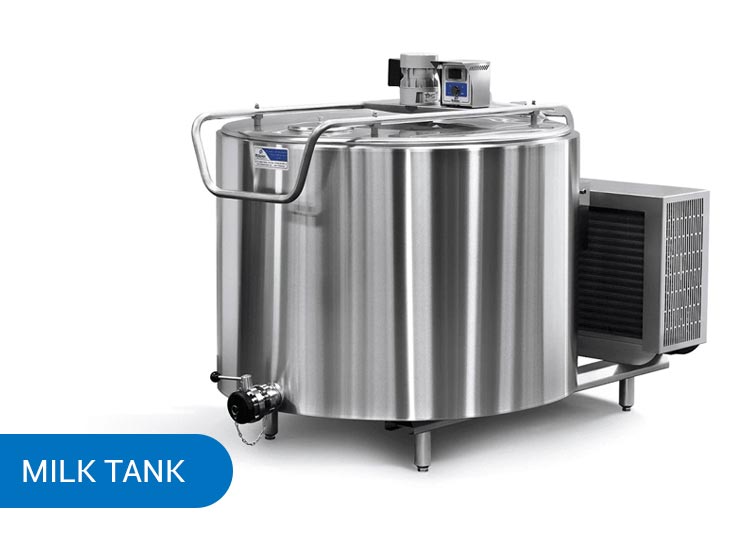
Pre-stack tanks, milk tanks, interim tanks, and mixing tanks are used to store liquid dairy products to keep them fresh for as long as possible. Therefore, they are crucial pieces of equipment for milk processing if you want to produce high-quality, fresh, and safe products.
Pasteurizers
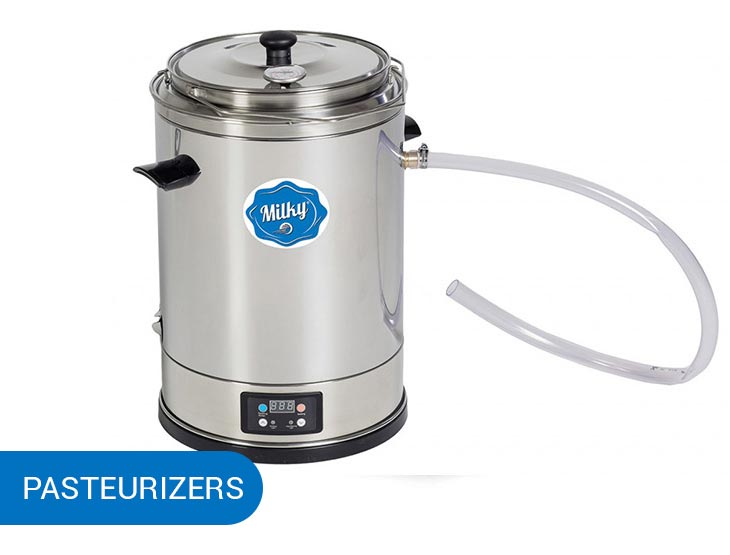
As we’ve already mentioned, pasteurization often lies at the core of milk processing. Pasteurizers are machines that will simplify this step for you. A milk pasteurization unit will heat the milk and keep it at a set temperature for a set duration, stirring it continuously and then cooling it down to make it ready for storing or further processing.
Cream Separators
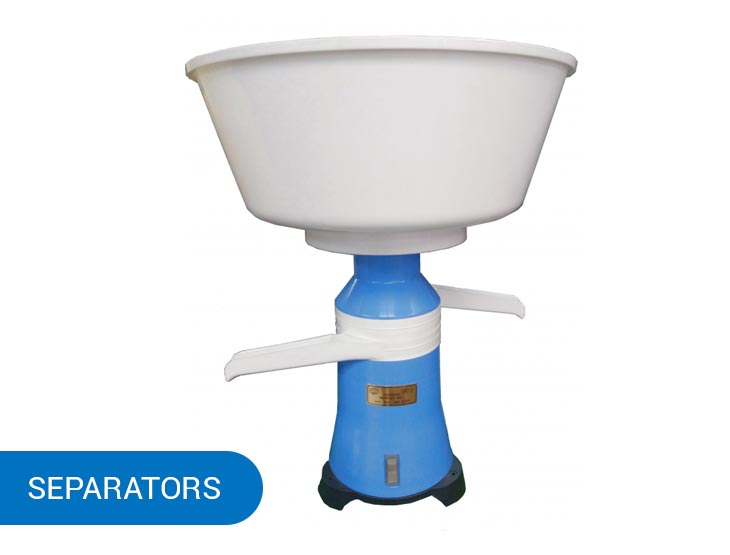
These machines are used for making low-fat and skim milk and cream. As a cream separator divides fat from milk, you get two products simultaneously — cream and milk that has a lower fat percentage. Depending on the working time of the cream separator, you can get milk and cream of different fat percentages.
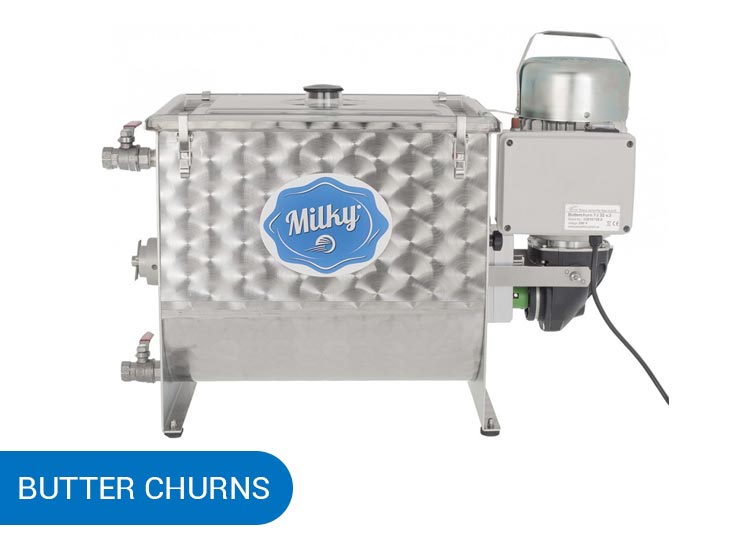
This milk processing device will churn milk into butter, leaving you with two products — butter and buttermilk. The second one is just as popular as butter, and you can sell it right away or ferment it to add more nutrients.
Cheese presses
It’s a very simple device that will apply pressure to cheese curds to squeeze out all the liquid and form cheese. You should choose a cheese press depending on the amount of the dairy product you’re planning to produce.
Homogenizers
This device improves the texture and taste of milk by making it more homogenized. The machine does it by squeezing milk through small holes under pressure, making the cells break apart and homogenize. Usually, this tool is used when you have milk from different cows and you want to make it more consistent.
How’s yogurt made?
It’s made through fermentation — you need to add special yogurt cultures to milk and keep it at a certain temperature for a while to activate the cultures. You can do that using a milk pasteurizer that supports low temperatures. A pasteurizer will be suitable for other fermented dairy products (e.g. fermented buttermilk, sour cream or kefir).
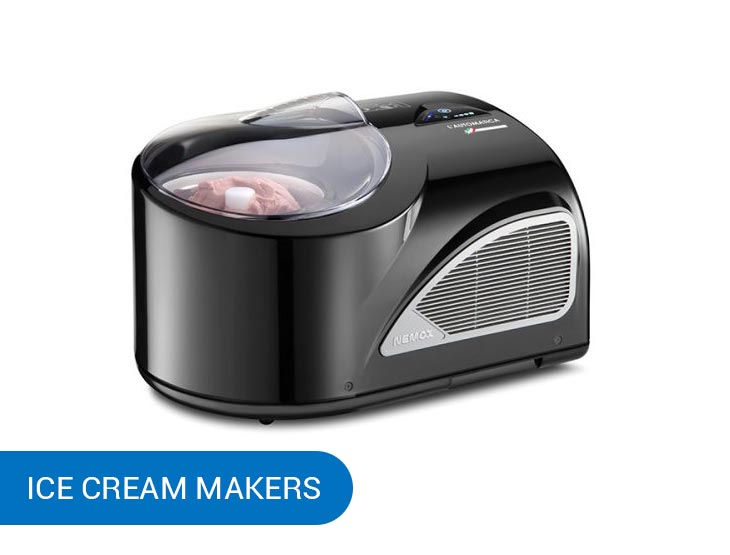
Ice cream makers
This machine is used in milk processing to make ice cream. It will churn the ice cream base slowly while cooling it down. The process creates ice cream with a smooth and creamy texture. No lumps or shards of frozen liquid.
Benefits of a small-scale dairy farm
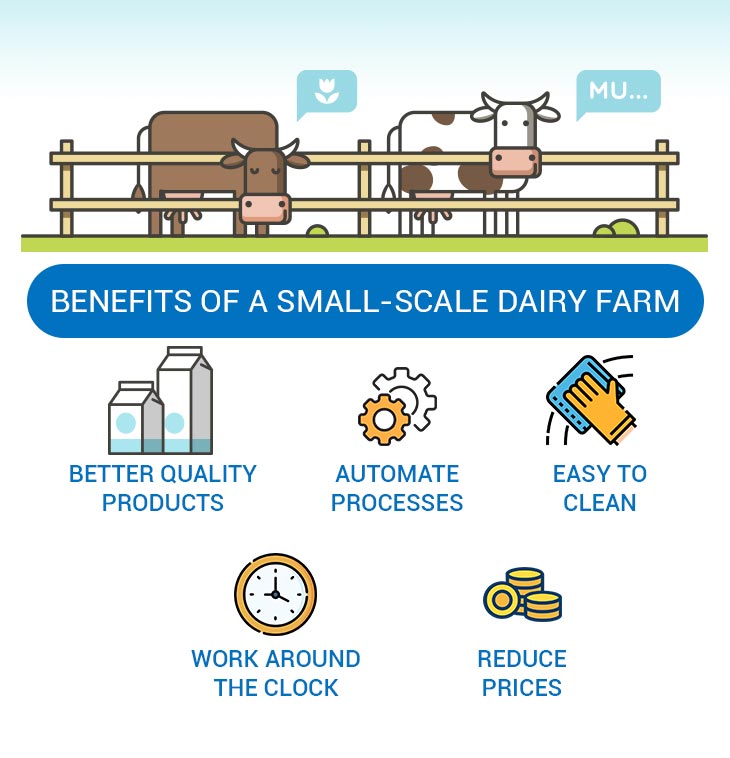
Sure, there is less hassle in selling simply milk. But dairy processing machines will give you much more freedom and let you make more revenue from your farm. Here are all the benefits you’re getting if you have a small-scale dairy farm:
You have products of better quality — Homogenizers, pasteurizers and milk tanks will help you improve the overall quality of your dairy.
Machines automate processes — Therefore, making dairy goods other than milk will not be a hassle. The equipment allows you to create products quicker and more easily while keeping the quality on point.
It’s easy to clean the machines — Advanced models are made to be easy to clean, so you don’t have to worry about spending hours cleaning the equipment.
Machines can work around the clock — Of course, there are models that need rest, but you can get equipment that can work 24/7 if you need continuous production.
You can reduce prices — Since creating dairy products will be less effort-consuming, you’ll have a chance to cut dairy milk processing plant costs and reduce prices to attract more customers.
Even a small farm can offer a variety of products today as equipment becomes more affordable and suited to small-scale production. If you have any more questions about milk processing equipment, just drop us a line and our Milky Day specialists will help you out.
Many baking recipes feature this mysterious ingredient: buttermilk. What is it? Is it some buttery milk? Do you get it by mixing milk and butter? Let’s explore this fascinating product and see if you should include it in your daily diet.
What is buttermilk?
When you churn butter, the fats get gathered into the spread we all love, leaving the liquid out. This liquid is a traditional buttermilk. It’s quite a rare sight in the USA and Europe, but families in India, Pakistan and Nepal drink this product every day. Such buttermilk is lower in fat than milk because almost all the fat has gathered into butter. It’s lower in calories too and is a good source of vitamins and nutrients.
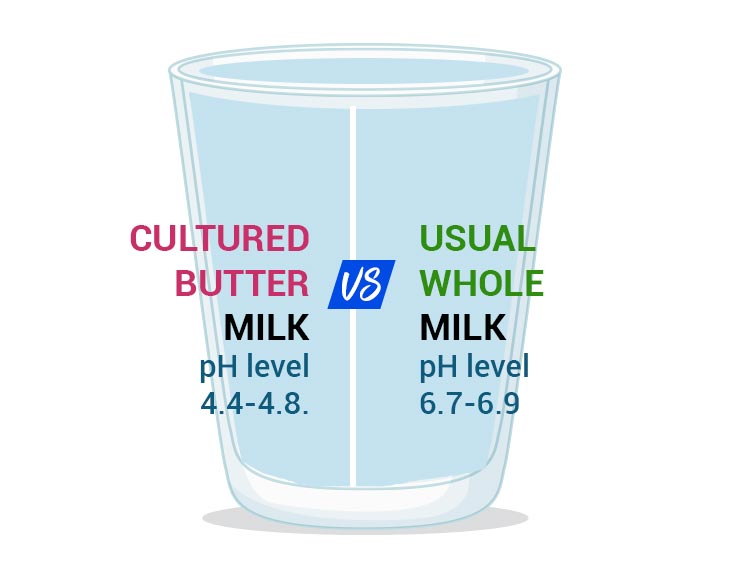
In the US, you can find cultured buttermilk that’s created by adding bacteria that produce lactic acid to pasteurized milk. This is a fermented product – the bacteria develop their qualities within 12-24 hours. Thanks to the lactic acid, cultured buttermilk can be stored for longer than milk. Also, it tastes sour and is much thicker. This beverage has a lower pH level because of the lactic acid. While standard milk’s pH is 6.7-6.9, the pH level of cultured buttermilk is 4.4-4.8.
What is buttermilk used for?
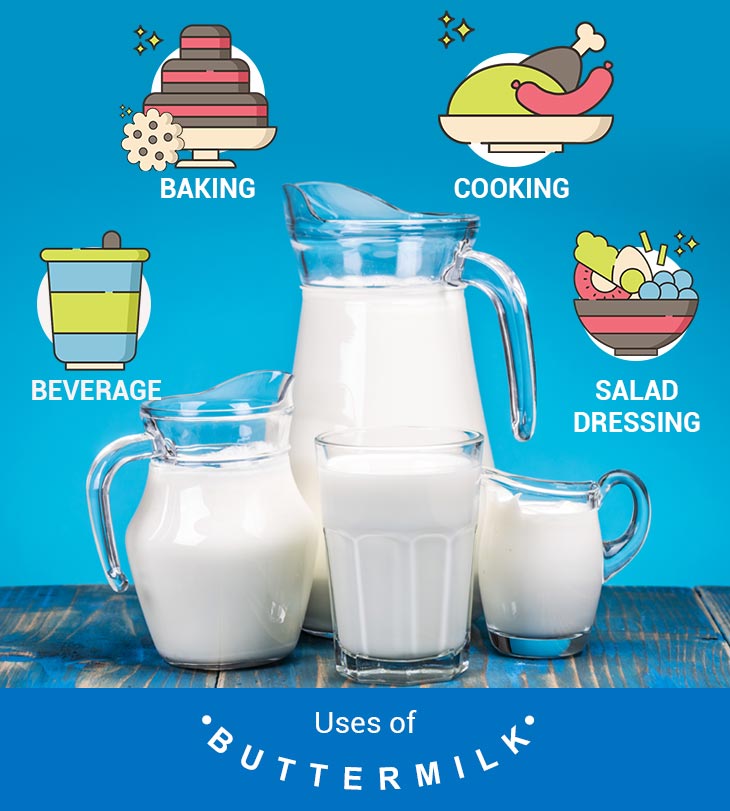
Some people like drinking both cultured and traditional buttermilk as standalone beverages or by adding salt or some other spices to them. Also, buttermilk is often used for cooking. It works very well as a substitute for other dairy products in recipes. Buttermilk is popular as an ingredient for baking, as it adds tenderness to the texture and a richer taste. This beverage is very versatile and can be used for virtually any dish – as a salad dressing, in a smoothie or soup.
Since cultured buttermilk stays good for around two weeks if you store it in the fridge, it is very convenient for those who just use this product for cooking. Unlike with milk, you don’t have to worry that it spoils quickly.
What is the difference between milk and buttermilk?
As we’ve figured out the obvious difference between these products – they are two different beverages – let’s take a look at other dissimilarities.
Cultured buttermilk might be a good choice for lactose-intolerant people because of the active cultures it contains. They can help you to digest lactose. However, the effect varies from person to person.
Also, fermented products are in general quite beneficial for our health. And as cultured buttermilk is a fermented beverage, it might reduce the risk of heart disease and improve digestion. Overall, it’s widely considered to be a healthier alternative to regular milk.
Buttermilk nutrition facts
245 ml (one cup) of cultured buttermilk contains only 98 calories along with 8 grams of protein, 12 grams of carbs and 3 grams of fat. Milk, on the other hand, has 157 calories and 8.9 grams of fat per 245 ml.
In addition, buttermilk is a good source of vitamin B12, calcium, potassium, phosphorus and riboflavin.
What are the benefits of drinking buttermilk?
As you’ve already noticed, buttermilk is a richer source of nutrients, and it’s lower in fat and calories. These and other features make this beverage rather beneficial.
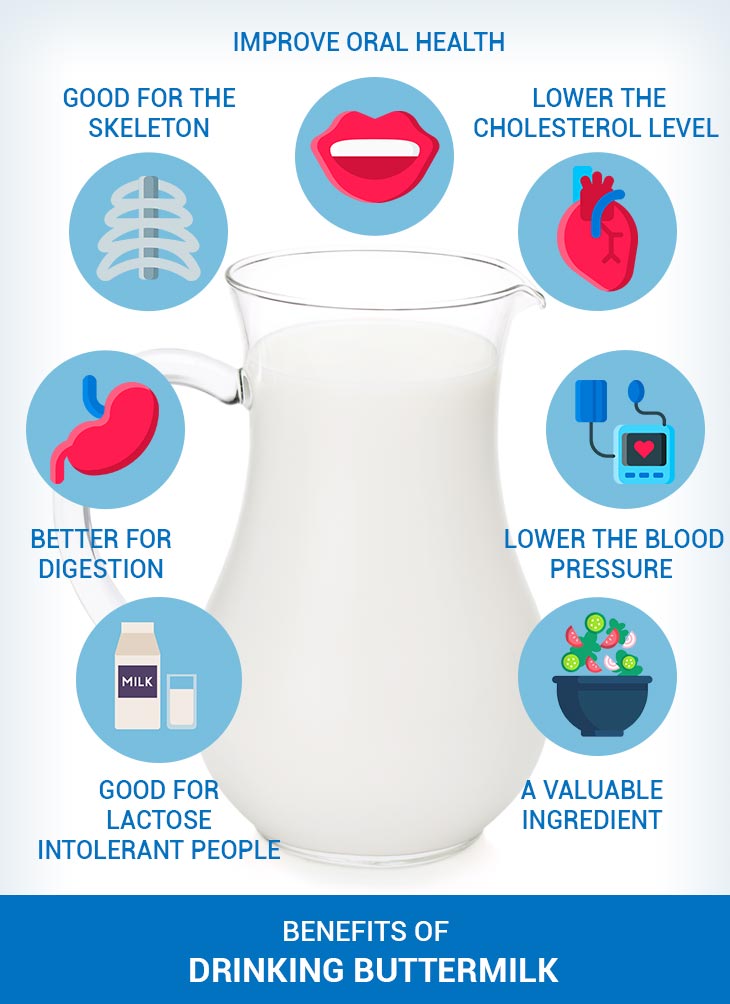
Lactose-intolerant people might not experience issues with buttermilk
Lactic acid and active cultures make this product easier to consume for those who are lactose-intolerant. Of course, it depends on the individual sensitivity of the person. Some will have no side effects from drinking buttermilk, whereas others might experience all the negative consequences, such as bloating, nausea and abdominal pain. But overall, cultures in buttermilk might help to break down the lactose.
It’s better for digestion
Fermented products are known for improving digestion, especially if a person already has some gastric issues. Active cultures help the body process food. They have a somewhat cooling effect that can help to calm down the stomach after eating a spicy meal. Also, buttermilk might make you feel lighter and less tired after a very heavy meal.
It’s good for the skeleton
As buttermilk is rich in calcium and phosphorus, it might help strengthen the bones and prevent osteoporosis and other bone diseases. Unlike standard milk, buttermilk is not that high in fats and calories, so you can consume this beverage to improve your bone structure without worrying about extra calories.
Active cultures can improve your oral health
Buttermilk has a cooling effect due to active cultures and lactic acid. So it can help with inflammation in your gums and body overall. And thanks to the calcium that is found in this beverage, you will lower your chances to develop periodontitis – the disease that causes inflammation of the gums and supporting structures of the teeth.
Helps to lower the cholesterol level
Studies have shown that buttermilk might help reduce cholesterol in the human body. Researchers suppose that this effect is caused by sphingolipid compounds that inhibit the absorption of cholesterol. Buttermilk’s milk fat globule membrane contains sphingolipids, so they’re a fair part of this product.
It might lower blood pressure
Research shows that cultured buttermilk might help lower blood pressure. Even though it’s not clear yet how exactly the beverage accomplishes this, we can assume that it happens thanks to the anti-inflammatory and cholesterol-lowering abilities of buttermilk. As the inflammation and cholesterol get reduced, it’s easier for the body to operate, and its blood pressure lowers.
A valuable ingredient
Buttermilk adds richness and tanginess to dishes while not significantly increasing their caloric value. Those who love baking cherish this product because it makes baked goods more tender, fluffy and tasty. Buttermilk is a good emulsifier and adds quite a lot of nutrients to our food.
How do you make buttermilk?
If you want to get traditional buttermilk, you can begin with churning your own butter. As the fat in the cream gathers into butter, you will get more and more of the leftover liquid. This liquid is what’s called traditional buttermilk. Using this approach, you will make two products at the same time: butter and buttermilk.
If you want to make cultured buttermilk, there are several ways to do it. The simplest will be to use a buttermilk starter. You can search for one in grocery stores or on Amazon, for example. All you need to do is follow the instructions on the package of the starter. Usually, all you need to do is mix milk with the starter, cover the container with a towel and let it sit in a warm spot at 70°-77°F for 12-24 hours. Some people prefer the texture that develops after 12 hours. It’s up to you to experiment and see when you want to stop the fermentation process by putting the buttermilk in the fridge.
Another approach is to mix milk with lemon juice or vinegar. The ratio is 1 cup of milk or heavy cream – it depends on the amount of fat you want the buttermilk to contain – to 1 tablespoon of lemon juice or distilled white vinegar. Mix these two ingredients and let them sit at room temperature for around 5-10 minutes. The milk will thicken and form small curds.
Finally, you can culture store-bought buttermilk by mixing it with a starter or a special buttermilk starter. You can add a bit of milk as well to add sugar for bacteria to produce lactic acid. Once you mix buttermilk with a starter, you can leave it at room temperature for 18-24 hours. The longer you keep the mixture at room temperature, the thicker and tangier it will be.
Bottom line
Buttermilk is a great product both for cooking and consuming as a beverage. It has many health and taste benefits, and it’s quite easy to make at home. You can store it for up to two weeks in the fridge and even freeze it. However, health experts don’t recommend freezing fermented dairy products, as they can lose their benefits. The best thing about buttermilk is that if you make it at home, you can make it taste as you like.