Butter churns are interesting implements used in the traditional process of making butter. They have a rich history dating back centuries and have played a crucial role in households, farms, and communities around the world.
A butter churn is a container or apparatus designed to agitate cream or milk until it separates into butter and buttermilk. It typically consists of a wooden or metal container with a handle or crank attached to a paddle or dasher inside. The churn is operated by hand, with the rhythmic up-and-down or back-and-forth motion creating the necessary agitation to transform cream into butter.
Butter Churns come in various shapes and sizes, reflecting the diverse cultural and regional practices of butter-making. They can range from simple hand-held churns used by individuals or small families to larger, more elaborate churns used in commercial settings.
Using a butter churn allows one to experience the traditional and time-honored method of producing butter. It connects us with our heritage, reminding us of the labor and craftsmanship involved in food preparation before the era of modern conveniences. Additionally, making butter with a Churn Offers a sensory experience, as the rhythmic motion and sound create a unique connection with the process.
DAIRY INNOVATION TRENDS 2022 FOR SMALL AND MEDIUM-SIZED FARMS
Every year, a new development impacts the dairy industry. This year is no exception. There are plenty of new trends that can allow us to gain a better understanding of what our next move should be to bring customers exactly what they need.
However, many of these trends are quite useless for small and medium-sized farms. So we decided to pick out only the most suitable trends for you to save your time and effort.
Sustainability
The main trend is dictated by the eco-friendly movement that’s been going on for years now. Small and medium-sized farms are already quite sustainable because they don’t have huge factories or herds that cause a negative impact on the environment. But there is always room for improvement.
Research from 2020 shows that 67% of consumers care about the health of our planet, and they prefer producers that have the same outlook. We can be sure that this number has only grown since then. Therefore, it’s vital to analyze the way you manage your farm and adjust it to the expectations of consumers.
51% of U.S. consumers care about animal welfare and wish to support farms that provide their animals with good conditions. So that would be a good place to start your journey toward sustainability. You can take a look at the way your kettle is handled and see if you can make any changes to make it less stressed and happier. Find inspiration from all those funny videos of cows scratching their backs on special brushes and playing with toys in a field.
By the way, if you film your kettle having fun, it could be some nice social media content to promote your farm.
Thoughtful waste disposal, planting cover crops, protecting water and soil, and other ways to reduce your carbon footprint could also represent steps toward an even greener farm.
Cognitive and mental health
The COVID-19 pandemic wreaked havoc on many people’s mental health. With more free time on our hands, we contemplated how to improve it. While it might not be the most obvious solution, dairy can have a positive impact on our mental health. Numerous studies show that more protein in our diet helps us be less anxious and depressed. Dairy is rich in protein. Also, milk contains the amino acid tryptophan that helps us sleep better, thus allowing us to feel more rested and improving our mental state.
It’s a good idea to market your dairy from this perspective since people keep looking for ways to improve their cognitive abilities and mental health. And we might see an increased demand for the main dairy foods because of this trend.
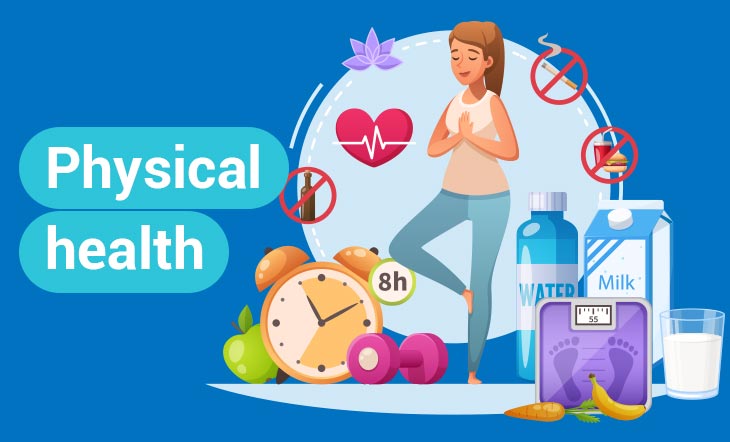
Who doesn’t want to be healthy? Stress, fast food and the fast pace of life, amplified by the fact that people have less time and energy for exercise, impact our health negatively. Dairy is one of the best solutions for strengthening our bones, improving gut health and digestion, keeping our cardiovascular system in a good shape and much more. You can read about all the health benefits of dairy in one of our previous articles.
By raising awareness of the health benefits of dairy, small and medium-sized farms can attract more local consumers who are seeking ways to improve their wellbeing. If you aren’t selling yogurt and other fermented dairies yet, you should think about doing that, as these foods have even more health benefits. It’s easy to create fermented dairy using suitable bacteria and a milk pasteurizer.
This trend of dairy farming in the U.S. refers to the sustainability movement. Consumers want the packaging of their products to be more eco-friendly and, in the best-case scenario, reusable. The top dairy producers have to come up with something new to cater to this requirement because it’s not easy for them to offer reusable packaging. But small and medium-sized farms have a simple solution: good old glass jars.
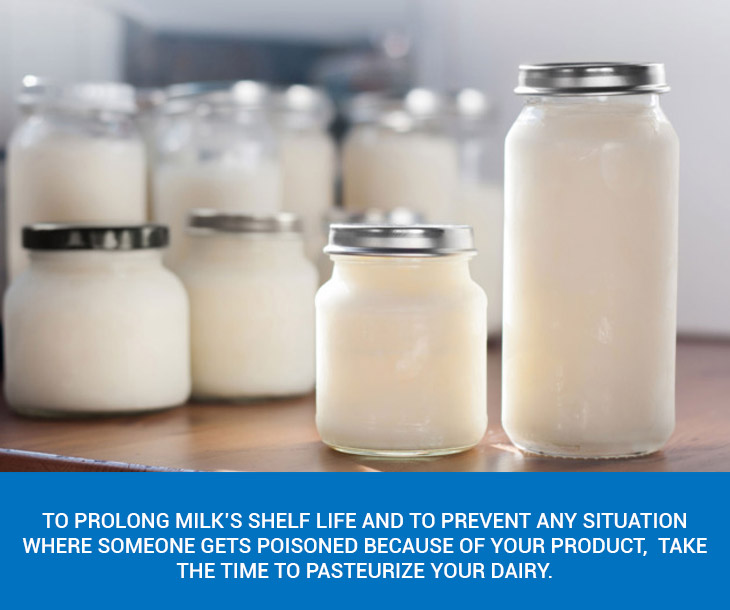
In all likelihood, you are already using them as packaging for your dairy products. You can also encourage your customers to bring the jars back to you so that you can clean them properly and reuse them. To assure them that this is safe, you can tell them in detail about the cleaning process and even show them how it works. Reusable packaging is a great way to sell more dairy in 2022.
This trend is huge in every industry—not only for milk farms in the U.S. Businesses around the world are doing their best to digitalize their processes in order to make them more efficient and better market their products. While implementing this tendency in a small or medium-sized dairy farm can be tricky, there are digital solutions that can ease your work.
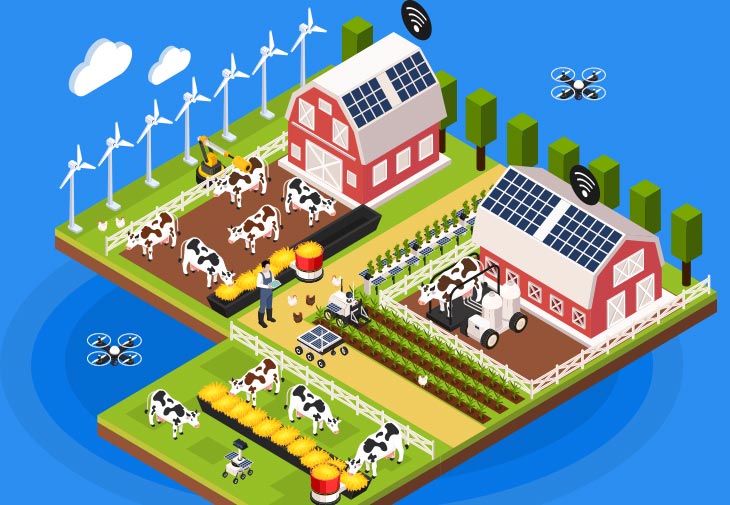
From robotic milking to AI predictions and digital-based cattle management, technology can simplify the processes on your farm. That is precisely what it was created for: to take some of the load off our shoulders. Try searching for some solutions you could implement on your farm that would make your everyday routine easier for you as well as reduce the costs of your processes.
These are trends that are affecting the dairy industry in 2022. Some of them might be not new to you, as they’re influenced by tendencies that already existed before. And some may seem too difficult to implement into your workflow. However, something being a trend doesn’t mean you absolutely have to try it. On the other hand, it never hurts to find new ways to improve things both in terms of the work you need to do and the revenue you bring in.
So look at this list of trends as tips and inspiration for upgrading your dairy farm and getting more customers.
The debate on whether dairy is good or bad for you never seems to end. Well, we’ve also decided to take part in this conversation. There are a lot of different beliefs surrounding this topic. However, many of them aren’t based on some substantial scientific evidence but rather on the personal preferences and health differences of each human being.
In this article, we will highlight all the benefits of dairy as well as the negative impacts it might have on your health and beauty.
Is dairy good or bad?
Here’s a quick answer: If you’re not lactose-intolerant, dairy is good for you. Even if you are, though, there is an abundance of lactose-free dairy to be found. You can also get lactase (an enzyme that basically eats lactose sugar) at a pharmacy. Just take it before consuming dairy and you’re good to go.
If you’re one of the lucky people without lactose intolerance, dairy can have a positive impact both on your health and looks. It improves your bone density and gut health. It can strengthen your nails and hair and improve your complexion as well.
Of course, everything is only good in moderation. The Dietary Guidelines for Americans encourage people to consume three servings of dairy daily. That’s how much milk you should drink a day. But if you drink more of it, you might encounter negative consequences. So chugging milk without consideration won’t help you become healthier—especially considering that our bodies can only digest so many nutrients and vitamins. The excess will just leave the system naturally. In the worst-case scenario, you might get nutrient and vitamin overdose symptoms.
Now, let’s take a look at all the benefits and possible risks in detail.
Dairy and health
In this section, we will take a look at the health benefits of milk and dairy as well as their drawbacks.
Health benefits of dairy
Dairy has many benefits. If you were wondering whether milk and cheese have protein, the answer is yes, they do. Quite a lot of it. So if you’re trying to gain muscle without going over your calorie limit, dairy is a great option. There are just 90-150 calories in a cup of milk, and you can check the calorie value of your favorite yogurts, cheeses and other dairy products for more information.
Another good thing about dairy is the high amount of vitamins and micronutrients it contains. The most significant ones are vitamins B12, B7, B2, magnesium and, of course, calcium. The latter is very important for keeping our bodies running well and improving bone density. It’s especially vital for women to consume enough calcium, as they keep building their bones up until menopause. So it’s good to keep that bone-building going in order to be ready for menopause. Pregnancy can have a negative impact on bone density too.
Dairy can also reduce the risk of heart disease and stroke thanks to the fatty acids it contains. However, if you already have issues with your cardiovascular system, you should talk to your doctor about your dairy intake.
Casein and the whey proteins found in dairy improve the mineral absorption of our bodies and serve as anti-inflammatory and anti-oxidative remedies. This can benefit both the health and condition of your skin.
Fermented dairy has an even more positive impact on our health thanks to the bacteria it contains. It can help with gut health and improve digestion. Honestly, we’ve tested this on ourselves and can say with confidence that even a cup of good yogurt or kefir makes your gut work much better.
Finally, dairy helps to repair muscle. It benefits post-exercise muscle synthesis and re-hydrates our muscles, thus bringing us more results from our workouts and making that post-workout soreness lighter and faster to go away.
We’ve already mentioned that if you have some issues with your cardiovascular system, you should talk to your doctor about whether you should consume dairy and what kinds of it you should focus on.
One of the biggest issues with milk—especially if you get it from unreliable sources—is that it might be contaminated with hormones, antibiotics and pesticides. Thanks to the latest regulations, dairy producers are now more careful with such things, so the amount of contaminated milk is much lower. However, if you get dairy from a local farm, inform yourself about its approach.
You should be careful with dairy paired with sugar and processed products. When we consume dairy, our bodies begin to break down the protein it contains and turn it into something similar to insulin hormones. Mix that with sugary and processed foods, and you’ll get an even higher level of insulin, as your body will try to deal with the sugar levels. A high level of insulin leads to inflammation that will disrupt your health and affect your skin. That’s why you should be careful with all those fruity yogurts, ice cream and other dairy mixed with sugar.
Then there’s lactose intolerance. If you feel unwell after consuming dairy, get bloated and gassy, and your bowel movements become irregular, you might be intolerant to lactose. As we’ve already said, try lactose-free dairy or the lactase enzyme. With that said, not all dairy products will make you feel bad—even if they contain lactose. Many people wonder, “Does yogurt have lactose?” The majority of fermented dairy products do not have large concentrations of the lactose. Greek yogurt, for example, contains very little lactose if made correctly. But you can’t really be sure if it was made correctly.
You can make your own fermented dairy at home using lactose-eating bacteria and our milk pasteurizers. This way, you will know for sure your dairy is safe to consume. Check out our range of milk pasteurizers and pick the one that fits your needs. If you’re struggling to identify which one is right for you, just drop us a line and we will help you.
Can you gain weight by consuming dairy?
Dairy is fairly low in calories, so if you consume it in moderation, you won’t gain weight just from that. Remember that we gain weight when we continuously consume more calories than we spend. If dairy becomes a part of your healthy diet that stays within your calorie needs, you will not gain weight. Moreover, you might even lose a bit, as dairy improves digestion and thus has a positive impact on your metabolism.
Dairy and beauty
We’ve mentioned that the vitamins and micronutrients in dairy improve the condition of our nails and hair. They can have a good impact on our skin as well. While there is a belief that dairy causes acne and skin inflammation, research is still ongoing on this topic. Dairy contains retinol and vitamin D, which are among the most popular anti-aging and anti-inflammatory remedies. Calcium, potassium, chlorides, sodium, magnesium, phosphor and other trace elements in dairy help to speed up cell regeneration, and the vitamins in dairy keep our skin moisturized and improve our complexion.
On the other hand, everyone’s body is different, and you should try staying off dairy for a while if you struggle with skin issues. If it helps, then not consuming dairy is right for you. If it doesn’t, then there is a problem with something else. If it helps, then dairy likely raises your insulin-like growth factor-1. Some studies show that people who struggle with acne tend to have an increased level of this hormone. Keep in mind that you should also be careful with mixing dairy and sugar. Increased levels of insulin can cause inflammation, and sooner or later, that will manifest itself as skin issues.
Interestingly enough, skimmed milk usually causes more skin issues than whole milk. Maybe that’s because of those fatty acids we were talking about in the health section. We have detailed articles about skimmed milk and whether it’s better than full-fat milk.
Dairy is mostly beneficial for both our health and beauty, so enjoy it if you don’t have any issues that come from consuming it.
Making dairy products by hand is too tough. So, if you manage a dairy farm, you must grasp the significance of each and every machine that is employed in the dairy industry. We will discuss the cream separator in this post, which is used to separate the cream from the milk.
With the advent of technology, any task can now be completed with the assistance of machines. If you want to start a dairy business, you must first grasp the importance of each machine that is utilized in the industry. Dairy equipment must be used with care in order to remain in good working order for a long time. Dairy machines contain a variety of equipment, including:
Cream Separators
Milk Pasteurizer
Butter churner
So, in this essay, we will go through the cream separator in great detail. If you want to start a dairy business, you should read this article attentively. First and foremost, you must learn how to use a milk cream separator.
What is a milk cream separator?
The milk cream separator is the most important piece of dairy equipment for separating milk from the cream. There are two types of separators on the market: manual and electric cream separators. Small business owners typically employ manual cream separators, but electric cream separators are used to create enough or too much cream from milk. The following are the main components of a separator:
Casing
Milk receiving tank
Electric Motor
Drum
Cream and skim milk receiver
The float chamber
To get the greatest quality product, you must verify all of the parts ahead of time. Let’s try to know the principles of the cream separators.
Principle of cream separators
Separators come in a variety of materials, productivity, and capacity, as we mentioned in the previous paragraph. Furthermore, you have the option of using a manual or electric cream separator, all of which operate similarly. These separate milk from cream, with the help of a drum and plates found in a milk separator. Separation of contaminants is also part of the separation process, which ensures that you get a high-quality product or cream.
The process of Separating Milk
If you’re using an electric cream separator, you’ll need to turn on the switch first and then wait for the engine to start correctly.
After that, pour roughly 1 liter of water into the cream separator before pouring the milk in.
After that, you must boil the milk at a high temperature for at least 2–3 minutes and repeat the process.
Separates the cream from the milk and stores it in the utensil at the end.
While there is a lot of controversy around pasteurization, the milk we can find on supermarket shelves is always pasteurized. And in many countries, it’s mandatory even for small farms to process their dairy. That’s why — no matter what side you’re on — it’s important to know all the details about the process, time, and temperature for pasteurizing milk.
What Is Milk Pasteurization?
In general, pasteurization is a process of heating food or drinks to a certain temperature and time in order to kill all the germs that might cause illnesses. So if you’re wondering what can be pasteurized, the answer is…just about everything. Merely by cooking food, you’re basically processing it and killing all the harmful bacteria.
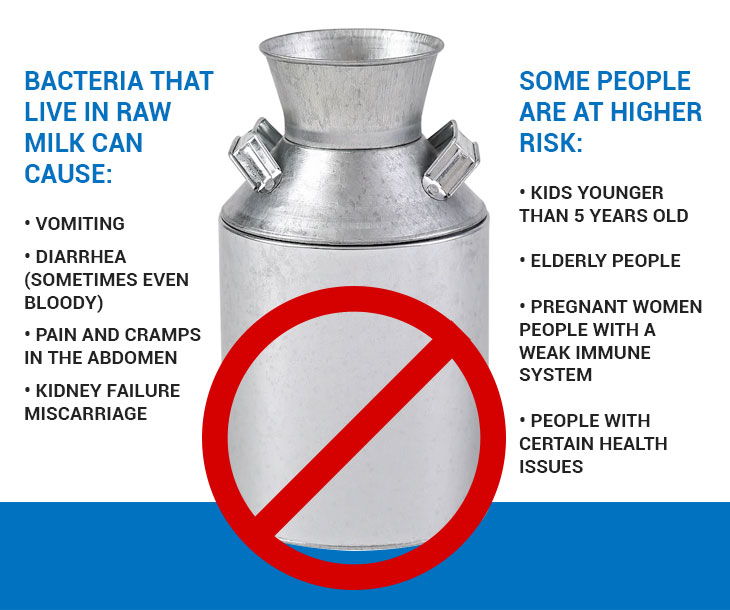
While a lot of people are not huge fans of processed milk, raw dairy products might cause:
Nausea and vomiting
Diarrhea
Pain or cramping in the abdomen
Kidney failure (in rare cases)
Miscarriage or death of an unborn baby
Some people are more vulnerable to the germs that raw milk might contain:
Kids below 5 years old
Elderly people
Pregnant women
People with immune system disorders (cancer, HIV, etc.)
People with certain health issues (diabetes, heart illnesses, etc.)
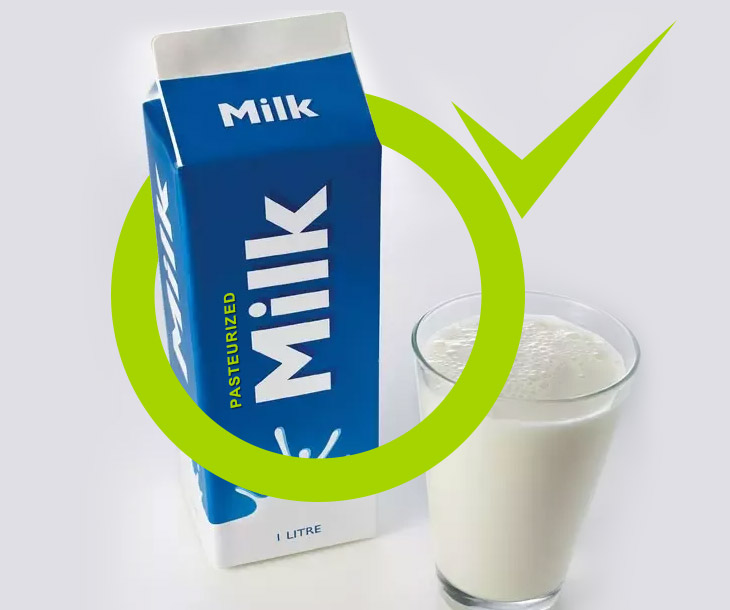
That’s why milk is made safe with pasteurization. These health risks are the reason many countries forbid the sale of raw dairy products. So often, both big manufacturers and small farms have to process their milk.
However, there are several countries where it’s not mandatory for farmers to pasteurize their dairy. If you buy milk from such retailers and are worried about its safety, you can easily process it at home. Also, the following instructions will be sufficient if you’re selling your dairy to locals and want to make sure no one gets sick.
Milk Pasteurization Process
What will you need:
A double boiler. You can use a thick-bottomed pot as well, but there is a risk that milk will burn on the bottom or get heated unevenly.
A sterilized kitchen thermometer
A spatula or large spoon
An ice bath. Fill a sink or large bowl with ice water.
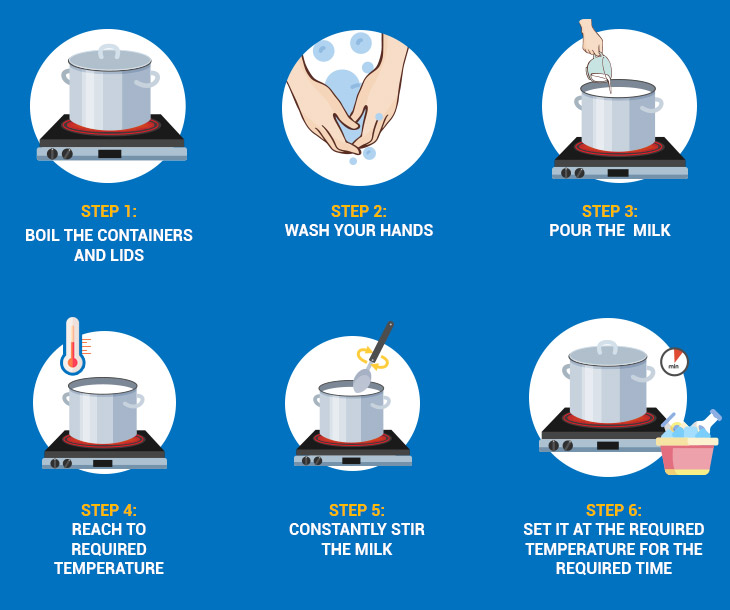
To begin the process, you need to clean the work area, wash your hands and sterilize the jars in which you’re going to keep the milk. You can sterilize containers by boiling them for a couple of minutes.
Once everything is clean, fill the bottom part of your double boiler with water and pour milk into the top part. You can use a regular pot too — just make sure you stir the milk the whole time so that it heats evenly and doesn’t burn. Put the double boiler or pot on the stovetop and turn the heat on low so that the milk heats up slowly. Use the thermometer to control the temperature. Once you reach the right temperature, keep the milk there for the required amount of time and then put it in an ice bath. Stir the milk so that it cools down faster, then pour it into jars and put it into the fridge.
Methods and Temperature for Pasteurizing Milk
The temperature for pasteurizing milk depends on the method you choose. The most popular methods are low temperature, HTST (high temperature, short time) and ultra-high temperature.
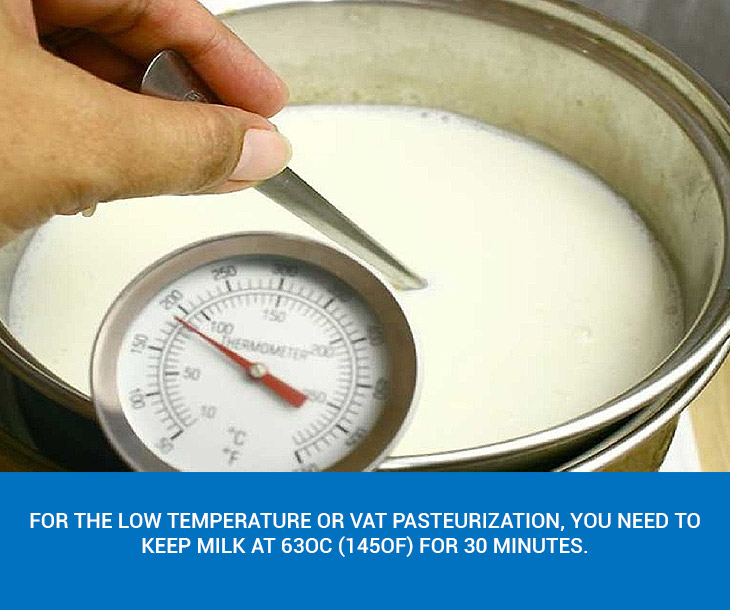
For low-temperature or VAT pasteurization, you need to keep milk at 63oC (145oF) for 30 minutes. This approach allows you to retain the texture and taste and is best for batch pasteurization. You could use a double boiler for this method, but it’s better to invest in a pasteurizer that will keep milk at the required temperature without needing you to watch over it. Advanced models will even cool the milk down after it’s processed.
HTST is the most common technique. It requires you to keep milk at 72oC (161oF) for just 15 seconds. This approach is feasible for home use and can be executed without any additional tools other than a cooking thermometer.
Ultra-high-temperature pasteurization will need you to heat milk to 138oC (280oF) and keep it at this level for only two seconds. However, this approach also involves sterilized packaging and is very hard to execute at home because it requires many additional tools. UHT pasteurization is used by manufacturers. It allows them to produce shelf-safe milk that doesn’t require refrigeration until it’s opened.
How Long Can You Store Pasteurized Milk?
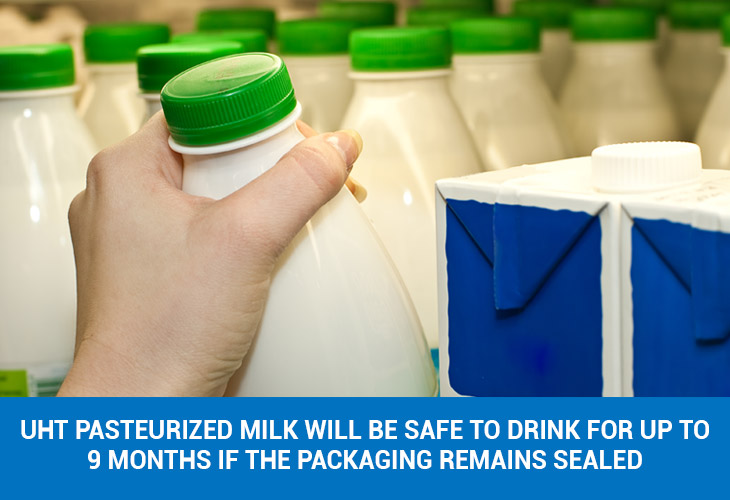
Obviously, the UHT method is the most beneficial in terms of shelf life. Such milk will be safe to drink for up to nine months if the packaging remains sealed.
HTST and VAT pasteurization are much easier to do at home. You can store such milk in the fridge at around 4oC (40oF) for up to two weeks. However, make sure you pasteurize it as soon as possible after it is gathered.
Unless you sell dairy and the government requires you to process it, it’s up to you whether you pasteurize your milk or not. Many people don’t feel safe drinking raw milk, so it’s useful to be aware of pasteurization methods in order to lower the risk of illnesses or other negative reactions.