Butter churns are interesting implements used in the traditional process of making butter. They have a rich history dating back centuries and have played a crucial role in households, farms, and communities around the world.
A butter churn is a container or apparatus designed to agitate cream or milk until it separates into butter and buttermilk. It typically consists of a wooden or metal container with a handle or crank attached to a paddle or dasher inside. The churn is operated by hand, with the rhythmic up-and-down or back-and-forth motion creating the necessary agitation to transform cream into butter.
Butter Churns come in various shapes and sizes, reflecting the diverse cultural and regional practices of butter-making. They can range from simple hand-held churns used by individuals or small families to larger, more elaborate churns used in commercial settings.
Using a butter churn allows one to experience the traditional and time-honored method of producing butter. It connects us with our heritage, reminding us of the labor and craftsmanship involved in food preparation before the era of modern conveniences. Additionally, making butter with a Churn Offers a sensory experience, as the rhythmic motion and sound create a unique connection with the process.
The debate on whether dairy is good or bad for you never seems to end. Well, we’ve also decided to take part in this conversation. There are a lot of different beliefs surrounding this topic. However, many of them aren’t based on some substantial scientific evidence but rather on the personal preferences and health differences of each human being.
In this article, we will highlight all the benefits of dairy as well as the negative impacts it might have on your health and beauty.
Is dairy good or bad?
Here’s a quick answer: If you’re not lactose-intolerant, dairy is good for you. Even if you are, though, there is an abundance of lactose-free dairy to be found. You can also get lactase (an enzyme that basically eats lactose sugar) at a pharmacy. Just take it before consuming dairy and you’re good to go.
If you’re one of the lucky people without lactose intolerance, dairy can have a positive impact both on your health and looks. It improves your bone density and gut health. It can strengthen your nails and hair and improve your complexion as well.
Of course, everything is only good in moderation. The Dietary Guidelines for Americans encourage people to consume three servings of dairy daily. That’s how much milk you should drink a day. But if you drink more of it, you might encounter negative consequences. So chugging milk without consideration won’t help you become healthier—especially considering that our bodies can only digest so many nutrients and vitamins. The excess will just leave the system naturally. In the worst-case scenario, you might get nutrient and vitamin overdose symptoms.
Now, let’s take a look at all the benefits and possible risks in detail.
Dairy and health
In this section, we will take a look at the health benefits of milk and dairy as well as their drawbacks.
Health benefits of dairy
Dairy has many benefits. If you were wondering whether milk and cheese have protein, the answer is yes, they do. Quite a lot of it. So if you’re trying to gain muscle without going over your calorie limit, dairy is a great option. There are just 90-150 calories in a cup of milk, and you can check the calorie value of your favorite yogurts, cheeses and other dairy products for more information.
Another good thing about dairy is the high amount of vitamins and micronutrients it contains. The most significant ones are vitamins B12, B7, B2, magnesium and, of course, calcium. The latter is very important for keeping our bodies running well and improving bone density. It’s especially vital for women to consume enough calcium, as they keep building their bones up until menopause. So it’s good to keep that bone-building going in order to be ready for menopause. Pregnancy can have a negative impact on bone density too.
Dairy can also reduce the risk of heart disease and stroke thanks to the fatty acids it contains. However, if you already have issues with your cardiovascular system, you should talk to your doctor about your dairy intake.
Casein and the whey proteins found in dairy improve the mineral absorption of our bodies and serve as anti-inflammatory and anti-oxidative remedies. This can benefit both the health and condition of your skin.
Fermented dairy has an even more positive impact on our health thanks to the bacteria it contains. It can help with gut health and improve digestion. Honestly, we’ve tested this on ourselves and can say with confidence that even a cup of good yogurt or kefir makes your gut work much better.
Finally, dairy helps to repair muscle. It benefits post-exercise muscle synthesis and re-hydrates our muscles, thus bringing us more results from our workouts and making that post-workout soreness lighter and faster to go away.
We’ve already mentioned that if you have some issues with your cardiovascular system, you should talk to your doctor about whether you should consume dairy and what kinds of it you should focus on.
One of the biggest issues with milk—especially if you get it from unreliable sources—is that it might be contaminated with hormones, antibiotics and pesticides. Thanks to the latest regulations, dairy producers are now more careful with such things, so the amount of contaminated milk is much lower. However, if you get dairy from a local farm, inform yourself about its approach.
You should be careful with dairy paired with sugar and processed products. When we consume dairy, our bodies begin to break down the protein it contains and turn it into something similar to insulin hormones. Mix that with sugary and processed foods, and you’ll get an even higher level of insulin, as your body will try to deal with the sugar levels. A high level of insulin leads to inflammation that will disrupt your health and affect your skin. That’s why you should be careful with all those fruity yogurts, ice cream and other dairy mixed with sugar.
Then there’s lactose intolerance. If you feel unwell after consuming dairy, get bloated and gassy, and your bowel movements become irregular, you might be intolerant to lactose. As we’ve already said, try lactose-free dairy or the lactase enzyme. With that said, not all dairy products will make you feel bad—even if they contain lactose. Many people wonder, “Does yogurt have lactose?” The majority of fermented dairy products do not have large concentrations of the lactose. Greek yogurt, for example, contains very little lactose if made correctly. But you can’t really be sure if it was made correctly.
You can make your own fermented dairy at home using lactose-eating bacteria and our milk pasteurizers. This way, you will know for sure your dairy is safe to consume. Check out our range of milk pasteurizers and pick the one that fits your needs. If you’re struggling to identify which one is right for you, just drop us a line and we will help you.
Can you gain weight by consuming dairy?
Dairy is fairly low in calories, so if you consume it in moderation, you won’t gain weight just from that. Remember that we gain weight when we continuously consume more calories than we spend. If dairy becomes a part of your healthy diet that stays within your calorie needs, you will not gain weight. Moreover, you might even lose a bit, as dairy improves digestion and thus has a positive impact on your metabolism.
Dairy and beauty
We’ve mentioned that the vitamins and micronutrients in dairy improve the condition of our nails and hair. They can have a good impact on our skin as well. While there is a belief that dairy causes acne and skin inflammation, research is still ongoing on this topic. Dairy contains retinol and vitamin D, which are among the most popular anti-aging and anti-inflammatory remedies. Calcium, potassium, chlorides, sodium, magnesium, phosphor and other trace elements in dairy help to speed up cell regeneration, and the vitamins in dairy keep our skin moisturized and improve our complexion.
On the other hand, everyone’s body is different, and you should try staying off dairy for a while if you struggle with skin issues. If it helps, then not consuming dairy is right for you. If it doesn’t, then there is a problem with something else. If it helps, then dairy likely raises your insulin-like growth factor-1. Some studies show that people who struggle with acne tend to have an increased level of this hormone. Keep in mind that you should also be careful with mixing dairy and sugar. Increased levels of insulin can cause inflammation, and sooner or later, that will manifest itself as skin issues.
Interestingly enough, skimmed milk usually causes more skin issues than whole milk. Maybe that’s because of those fatty acids we were talking about in the health section. We have detailed articles about skimmed milk and whether it’s better than full-fat milk.
Dairy is mostly beneficial for both our health and beauty, so enjoy it if you don’t have any issues that come from consuming it.
Humanity is used to the idea of consuming animal-derived milk and dairy. We’ve been enjoying it since 8,000-10,000 BC. It’s been a cornerstone of our diets for ages. We value dairy for all the health benefits it brings, from filling us with energy to helping us build strong bones, develop muscles, improve our gut health and more. Milk boosts our immune system and works as an anti-inflammatory remedy and a probiotic.
Milk is still a very important part of the diet of people around the world—especially in poorer countries since it is a valuable source of calories and can help prevent issues in malnourished children. Many of us also just appreciate the taste of dairy products.
With that said, plant-based milk and dairy have become overwhelmingly popular lately. Today, cafes are expected to offer a range of plant-based milks for you to put in your coffee. And the amount of dairy products made of plant-based milk has increased significantly. In many places, it’s possible to find ice cream, fermented dairy, cheeses and other products made of plant-based milk.
In this article, we will try to figure out if plant-based milk can replace animal-derived milk in terms of health benefits.
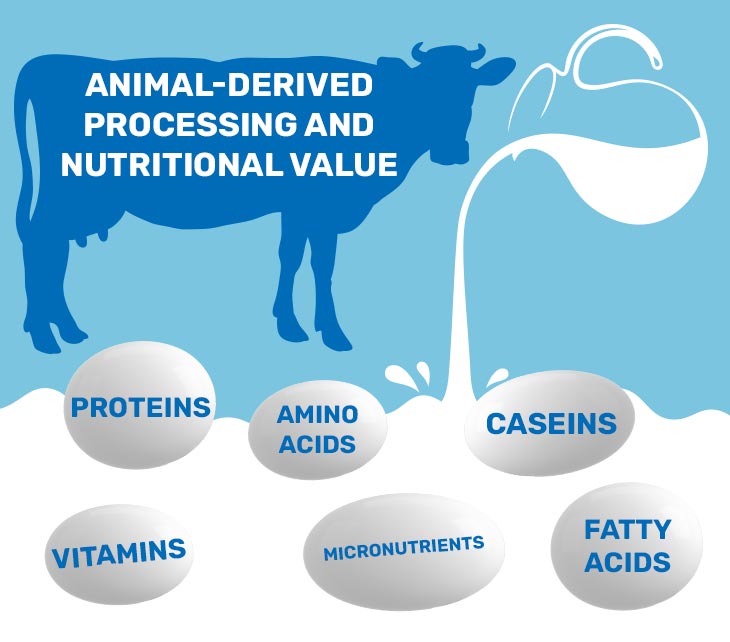
Animal-derived milk—processing and nutritional value
The value of animal milk is hard to overestimate. It’s clearly beneficial and it’s considered to be important to consume for a good reason. This product is rich in proteins, amino acids, fatty acids and numerous vitamins and micronutrients. We’ve recently conducted extensive research on all the health benefits and nutritional value of animal-derived milk. You can check it out here.
But there is another side of milk. When unpasteurized, it can cause health issues due to the harmful microorganisms it might contain. That’s why it’s mandatory in most countries to pasteurize milk gathered for sale. Small farms must pasteurize their dairy too—even if they’re selling it to just a couple of people. However, many people who gather milk for their own use avoid this step (usually because they believe that pasteurization makes milk less beneficial for their health and worsens its taste).
Here are our thoughts on whether pasteurized milk is better or worse than raw milk:
While that might be true, it largely depends on the method of pasteurization. The best one is Ultra-High Temperature (UHT) pasteurization. It requires heating milk to 135-150°C for just a few seconds. This method allows you to preserve as many nutrients and vitamins as possible and doesn’t change the milk’s taste.
It’s easy to pasteurize milk at home with a pasteurizer. You can also use this machine to make fermented dairy products! Check out our range of pasteurizers if you want to get one for your kitchen. And if you have any issues with choosing the most suitable one, you can always reach out to us.
As we learn more about all the benefits of animal-derived milk, a few questions arise: Why has plant-based milk become so popular? Why do people choose it instead of animal-derived milk? The simple answer is that plant-based milk can also bring many health benefits.
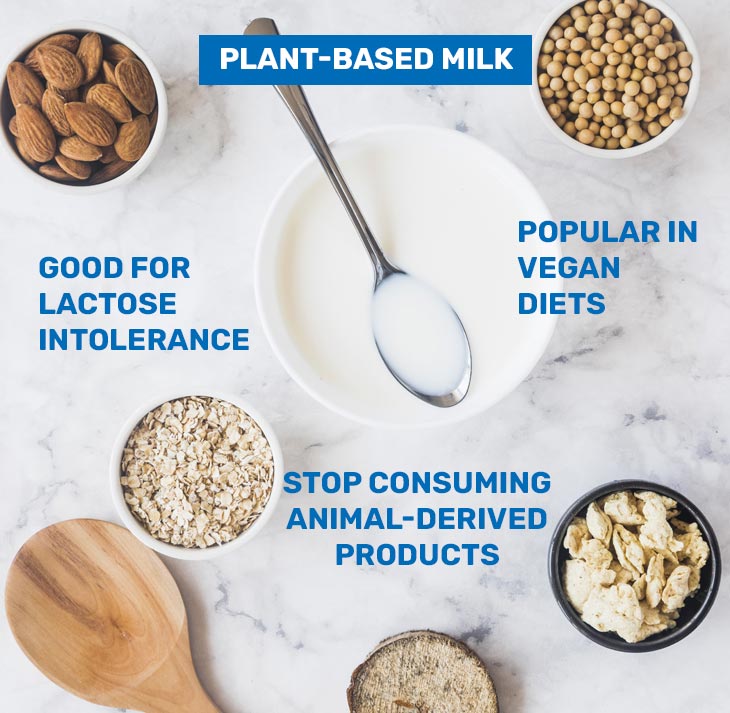
But there are other reasons why people switch to such milk. First of all, they might want to stop consuming animal-derived products altogether and go vegan for their own reasons. Secondly, some might simply like the taste of plant-based milk better.
Another reason would be lactose intolerance. People who are allergic to lactose (sugar that is found in milk) experience many unpleasant symptoms when consuming animal-derived dairy. That’s why they turn to plant-based alternatives. However, there are so many options for lactose-free animal-derived dairy that you don’t necessarily have to give up the taste and texture of traditional dairy.
Lastly, with vegetarian and vegan diets becoming so popular, plant-based milk has become trendy as well. As a result, some people switch to these drinks with the sole goal of following something that is considered to be in vogue.
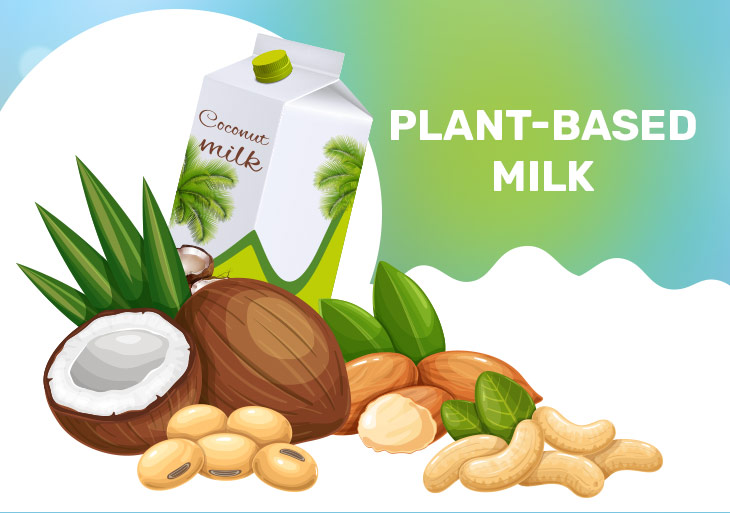
Benefits of plant-based milk
Plant-based milk can be divided into five types:
Cereal-based
Legume-based
Nut-based
Seed-based
Pseudocereal-based
Obviously, the health benefits of each type of plant-based milk come from the products each milk alternative is made of. For legumes, the benefits are that they’re rich in carbs, proteins, fiber, vitamins and minerals. Chickpeas are full of fibers, monosaccharides, disaccharides and oligosaccharides. Soy contains a lot of carbs, proteins, lipids, fatty acids and amino acids.
Seeds contain animal-like proteins (when heated, enzymatically treated or presented with acids, they behave like those found in animal-derived milk). Pumpkin seeds have a lot of lipids, protein and carbs. Flaxseed is rich in fatty acids. Often, seed-based milk is made of sesame seeds, but it’s not a very advantageous animal milk alternative, as sesame seeds lose quite a lot of health benefits when processed to become plant-based milk. When fermented with lactic acid β-glucosidase, though, sesame milk gains quite a strong antioxidant effect. That’s why it’s best to use this drink for making fermented dairy alternatives.
Cereal milk is quite popular too. Oats are high in fiber, vitamin E, β-glucan and polyunsaturated fatty acids. They also work well as a probiotic. Moreover, they contain flavonoids, carotenoids, phenolic acids and other bioactive phytochemicals. Rice is low in protein but high in nutrients. When fermented, it contains a lot of calcium, iron and magnesium, and works as a probiotic.
Nut milk is perhaps the most popular option. Almonds contain a lot of monounsaturated fatty acids, protein, fiber, manganese, vitamin E, antioxidants and more, which makes this milk alternative the healthiest plant-based milk. It’s also considered to be the best-tasting plant-based milk. Coconut milk can increase high-density lipoprotein, thus contributing to lowering cholesterol levels. It’s also a great alternative to animal-derived milk when it comes to making dairy products or cooking dishes that should contain dairy.
Let’s highlight some important facts about plant-based milk and animal-derived milk (we’re using cow’s milk as an example of animal milk):
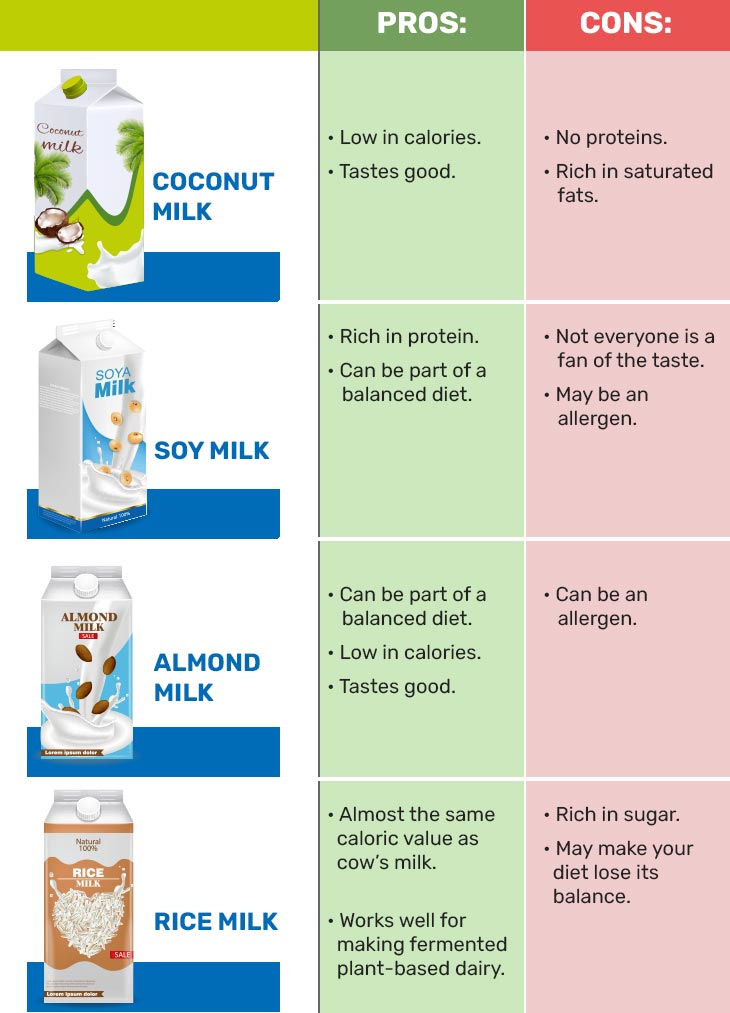
Coconut milk
Pros:
Low in calories.
Tastes good.
Cons:
No proteins.
Rich in saturated fats.
Soy milk
Pros:
Rich in protein.
Can be part of a balanced diet.
Cons:
Not everyone is a fan of the taste.
May be an allergen.
Almond milk
Pros:
Can be part of a balanced diet.
Low in calories.
Tastes good.
Cons:
Can be an allergen.
Rice milk
Pros:
Almost the same caloric value as cow’s milk.
Works well for making fermented plant-based dairy.
The main concern is that industrial plant-based milks often contain quite a few undesirable ingredients such as preservatives, thickeners and sweeteners. They might cause issues for your digestive system. Pesticides and other things plants are often presented with might become a health hazard as plant-based milk is made. All that dangerous stuff will appear in your milk alternative. The best approach, in our opinion, is to make plant-based milk at home from ingredients that were checked for any harmful elements.
Also, remember that vegan milk is low in proteins, calcium and vitamin D. So if you decide to replace animal-derived milk with it, make sure to get enough of those micro and macronutrients from other foods or supplements.
The best plant-based milk for coffee
Now, let’s talk about the fun part: the taste. While everyone has their own favorite when it comes to flavor, plant-based milk hits differently when mixed with coffee in terms of both taste and texture. Also, different vegan milks behave differently when heated and introduced to the acidity of coffee.
Soy milk
Its taste is quite neutral, which is a good thing when it comes to adding it to your cup of coffee. It offers similar performance to animal-derived milk when heated. But it might curdle when presented with the acidity or the temperature of the coffee.
Almond milk
Its nutty and bitter taste can be a good addition to coffee. Almond milk adds a nice extra flavor, but due to the lower protein content, it’s quite watery. It can also split when added to coffee.
Coconut milk
This milk alternative is the best one in terms of texture. It’s creamy and dense, so it makes a good base for froth and foam. However, it’s quite sweet. That’s why those who love the acidic and bitter taste of coffee might not like adding coconut milk to their drink. Also, the bubbly foam of coconut milk fades quicker than that of animal-derived milk.
Oat milk
Taste-wise, this is the best partner for coffee thanks to its wheaty notes. It’s also rather thick and creamy, so it makes a good foam and stretches well. Unfortunately, it might curdle when combined with coffee.
Cashew milk
This milk alternative is quite expensive because of the priciness of cashew nuts. However, it is very similar to cow’s milk when it comes to creaminess. The nutty flavor complements the coffee quite deliciously, but it’s rather sweet, so if you love a bitter cup of coffee, cashew milk is not for you. The foam it creates is very bubbly and fades quickly while also having a “bubble bath” texture that many might find unpleasant.
Rice milk
It has a neutral taste that is good for not spoiling your favorite coffee. But rice milk is also quite watery, so if you’re craving an Americano with milk, add this alternative to espresso. This plant-based milk also performs poorly if you want to make some foam with it.
Final thoughts
Everyone should decide for themselves whether they want to stick to animal-derived milk or switch to vegan alternatives. It all comes down to your preferences in terms of diet and flavor. Plant-based milk can offer quite a lot of health benefits, but it all depends on the way a producer processes all those legumes, nuts, seeds or cereal.
As adamant lovers of homemade products, we want to encourage you to make your own plant-based milk at home—especially since it’s rather easy to make!
Ten glories agone, humans domesticated a small herd of the wild ox in the Near East. And nearly times latterly, they started abusing them. Also, humanity’s preoccupation with cow milk has spread into a multi-billion bone assiduity and is still growing.
Ever since us clever homo sapiens figured out we could drink cow milk, the natural fact that milk separates naturally from cream has been part of that computation. We’ve figured out how to make adulation, ice cream (yum), rubbish, kefir, and more lately, whey protein maquillages and probiotic yogurts.
Still, you’re most likely part of that assiduity, If you’re reading this. Dairy processing shops are a necessary link between growers and consumers. And part of that process is the separation of millions of gallons of skimmed milk from the cream.
Cream Separators are hard-working, vital pieces of the outfit in your factory. But they were not cheap. In this blog, we’ll review what exactly a cream separator is, how it works, and how to land a high-quality cream division while staying within your budget.
What is a dairy Cream Separator?
A milk and cream separator is an extremely effective piece of artificial outfit that uses centrifugal force to remove cream from whole milk.
Similar separation is possible because, as those ancient humans noticed thousands of times agone, milk and cream naturally like to separate.
Remember the expression, “ You look like the cat who got the cream?” A mouser who waited long enough could sneak up to a pail of milk on a family ranch and simply master the cream off of the top. Milk cream separators when left to their own bias because they've different consistency. The cream is lighter, milk is heavier. How does a dairy cream separator work?
Just as graveness acts to naturally separate the milk and the cream, cream separators do the same thing — but much more snappily. As mentioned ahead, cream partitions use centrifugal force by feeding the raw milk into a central spinning chamber.
Within this chamber are conical fragment heaps that rotate in a barrel, creating centrifugal force thousands of times stronger than graveness. The fat within the milk stays within the center of the barrel, and the heavier skimmed milk is pushed to the external edges. In this way, a separation process that could take all night if left to nature is achieved in seconds.
Really, artificial milk processing — at the rates ultramodern shops run — would be insolvable without cream partitions. Cream separators guarantee milk fat thickness, and can also be modified to help with explanation and the junking of foreign objects and pathogens.
Note: Though we started this composition talking about cow milk, cream separators work extremely efficiently for scapegoat milk as well. In fact, using a cream division for scapegoat milk is indeed more important than for cow milk, as scapegoat milk cream has lower fat droplets, and therefore scapegoat cream separators at an important slower rate when left to graveness. What’s the most cost-effective way to purchase a reliable cream separator?
Like your mama might have told you when dragging you to the providence store before the first week of the academy, one secret to spending lower plutocrat is noway bought new. And this is true of the cream separator as well.
From both a time and plutocrat viewpoint, staying and paying for a brand new cream division is an extremely expensive process. Numerous name brands can take overtime to get you a new piece of an outfit. And if you need a new cream separator, you need its history.
That’s why our number one secret is to buy remanufactured.
The remanufactured outfit not only gets to you briskly but can bring up to 30 lower outspoken. What is a remanufactured cream separator?
The separator’s remanufacturing process starts with a complete disassembly of a used cream separation. Each and every part of the outfit is gutted, examined, and replaced or repaired if it doesn’t meet our norms. That means every bolt, spring, slice, stopcock, and frame of our remanufactured cream separator is like new and passes our rigorous quality norms.
For each remanufactured cream division, we also flatter ourselves in supplying an estimate of its mileage consumption, so that you know your functional costs moving forward. How can I ensure my cream separator is running at its most efficiently?
Running a cost-effective cream division isn't only about outspoken costs, but also the effectiveness of its day-to-day operation. This is why we recommend training each and every hand in stylish practices for starting and stopping your cream division outfit, as well as CIP protocols and troubleshooting.
Consider reaching us about our consulting and customized training programs, to ensure your people aren’t making time-and plutocrat-wasting crimes.
We also largely suggest that you upgrade the robotization of your cream partitions. Robotization technology is perfecting every month and can have an exceptional impact on outfit effectiveness.
How can I ensure my cream separator will last as long as possible?
Regular cream separator conservation should be about 2x/ time, and can significantly extend the lifetime of the outfit. We happily record conservation around factory time-out and work with you to help product detainments as much as possible.
We also have 24/7 phone response in case of extremities. We give same-day shipping on the relief corridor, and our platoon of technicians is ready and willing to fly directly to you to give expert in-person service.
Make the most of tight margins.
The dairy assiduity is extremely competitive, and paying further than necessary for essential equipment just doesn’t make sense.
Communicate with us to get more information on remanufactured cream separators. Our experts are always ready to dive in and discuss how to optimize your equipment, save you money, and keep your plant competitive.
Goat milk cream could be a natural product that comes from goat milk, however, unless you've got a milk cream separator a number of that cream goes to be pretty troublesome to get rid of.
Now that doesn't mean that you just cannot get the bulk of the cream of the goat milk, it simply implies that some are getting to be left behind.
The only downside is you may have to be compelled to either freeze the cream till you've got enough for your formula otherwise you are getting to have to be compelled to purchase a cream separator at the shop to supplement what comes off the goat milk.
How To Separate Goat Milk Thick Cream
As mentioned higher than, the best thanks to separate the cream from the goat milk is to use either a manual or electric cream separator.
These have come back a protracted manner in recent years and a tabletop version appropriate for a smaller quantity of milk is currently promptly accessible.
A cream centrifuge is largely a centrifugal device that separates the cream from the milk therefore you finish up with cream and milk.
There are each all-metal ones and ones that are made from plastic.
While the plastic ones are cheaper, my recommendation is to settle on one that's all metal therefore it lasts for years to come back.
Of course, must you decide to not pay the cash to shop for a cream separator, there's different to get rid of the cream from the goat milk.
Simply enable the goat milk to take a seat within the white goods nightlong or a minimum of between the morning and evening milking, then use a metal spoon to scoop off the maximum amount of the cream as you'll.
The cream will rise to the highest of the jar because the goat milk cools.
If you set your goat milk in an exceedingly clear glass instrumentality, it's simple to differentiate the cream from the goat milk as a result of the cream goes to make a thick darker white layer on the terribly prime of the goat milk.
When you take away the cream with a spoon it will appear reasonably thick and gloppy.
This is traditional.
Now by removing it employing a spoon, you're getting to miss some and additionally find yourself with a bit of milk within the cream.
Tips For Separating Thick Cream From Goat Milk
I like to relax my goat milk in pint canning jars crammed not quite 1/2 full once I pasteurize the goat milk.
While smaller amounts of milk mean there's a diluent layer of cream that forms on prime, I want this can be what works best on my behalf of me.
Now, if you retain your milk within the white goods for terribly long, or maybe freeze it, a thicker layer of cream would possibly type on prime of the goat milk, particularly if you probably did not savvy all scraped off with a spoon throughout your initial strive.
Just check the goat milk before you employ it and scrap off any that continues to be.
If you employ a cream separator for goat milk, however, this could not happen because the machine should take away all of the creams.
How To Use Thick Cream
There are several uses for cream.
Recipes like frozen desserts incorporate a combination of goat milk and cream.
Homemade topping needs the employment of cream.
Another fashionable use for cream is this goat milk butter formula.
Of course, there are different uses for cream likewise, and albeit, I favor taking away the cream from our goat milk before drinking it just because I don't just like the feel of the clod of cream once I drink it.
For people who favor laying aside their own cream and not using any factory-made cream in the least in their recipes, a simple thanks to trying this is to freeze the cream mistreatment identical technique wont to freeze goat milk.