Tuesday, September 27, 2022

HOMEMADE KEFIR AND ITS BENEFITS - Milky Day

 Do you want to improve your digestion and gut health, make your bones stronger and even lose weight? Then you should add kefir to your daily diet!

Kefir might sound somewhat exotic to you, but we believe you should try to include this drink in your diet—especially if you’re familiar with kombucha or other fermented foods. The taste is quite mild and kefir brings so many health benefits to the table.
what-is-kefir?

What is kefir?

Kefir is a fermented milk drink that originated in North Caucasus. It is very popular in Asia and Eastern Europe. It has a thick, creamy and slightly bubbly fermented texture as well as a mild sour taste. You can drink kefir as is, add your favorite sweetener to it or even use it for cooking pancakes, baking and more!

Craving some ice cream

Craving some ice cream? Make it at home! Here is how: https://milkyday.com/blog/2021/07/22/how-to-make-homemade-ice-cream-from-milk/

Health benefits of kefir

This drink offers many health benefits.
Health benefits of kefir

It contains many nutrients

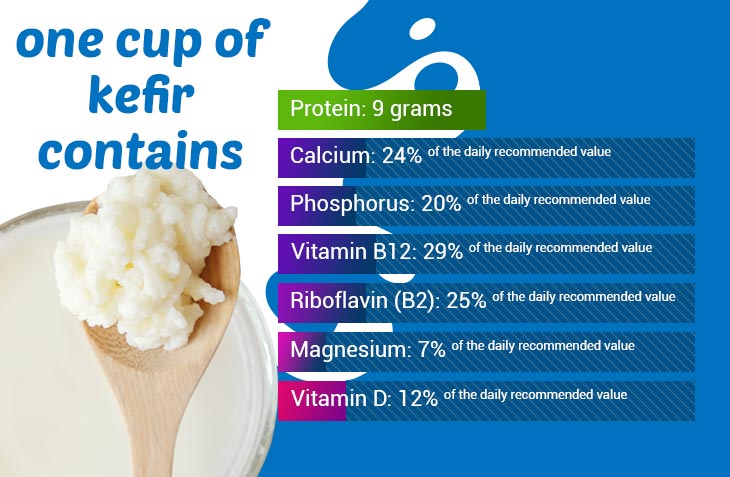
Here are all the nutrients contained in just one cup of kefir:

  • Protein: 9 grams
  • Calcium: 24% of the daily recommended value 
  • Phosphorus: 20% of the daily recommended value
  • Vitamin B12: 29% of the daily recommended value
  • Riboflavin (B2): 25% of the daily recommended value
  • Magnesium: 7% of the daily recommended value
  • Vitamin D: 12% of the daily recommended value

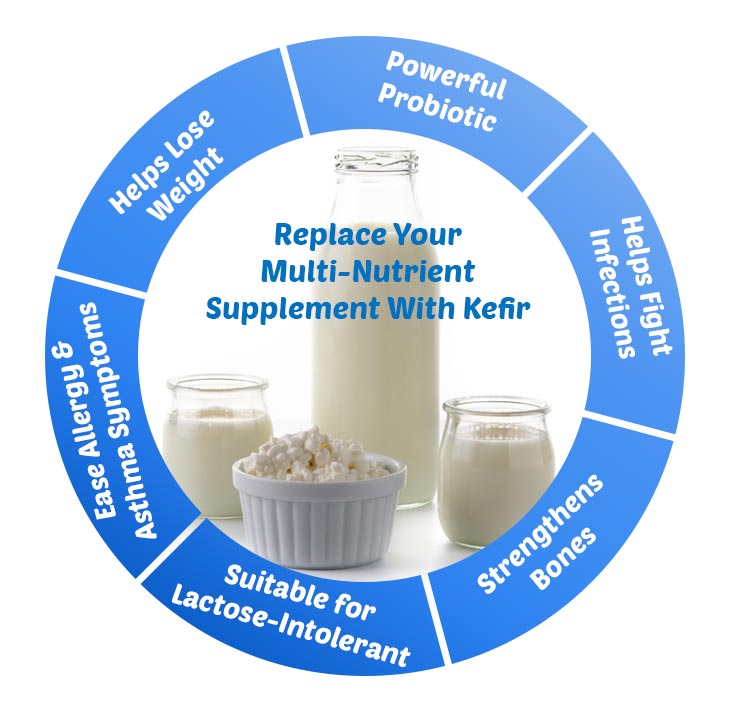
Yes, all this goodness is in just one cup of this drink! You basically can replace your multi-nutrient supplement with kefir.

It’s a powerful probiotic

We’re somewhat used to yogurt being a probiotic, and it is a good one. Kefir just happens to be even more powerful. Kefir grains contain up to 61 strains of bacteria and yeasts. This makes the drink a very rich and diverse source of probiotics—especially compared to other fermented dairy products that usually contain fewer strains and no yeasts. That’s why kefir is so good for your gut health.

Kefir significantly improves digestive function, reduces bloating and even speeds up your metabolism so that your body can process food faster. That’s why doctors in Eastern Europe and Asia often recommend that patients with gut illnesses add kefir to their diet.
Dairy products planner

It helps you fight infections

It’s getting better and better, isn’t it? Kefir is a true superfood that can also help protect against harmful bacteria thanks to the Lactobacillus kefiri probiotic it contains. It can help you fight Salmonella, Helicobacter pylori, E. coli and other harmful bacteria. Also, kefir contains a type of carbohydrate called Kefiran that improves your protection against nasty bacteria.

It strengthens bones and prevents osteoporosis

As a great source of calcium and vitamin K2—the latter helps the body process calcium—kefir is an ideal drink to keep your bones healthy. It improves the quality of bone tissue, thus making your bones denser and stronger. As a result, kefir can make you less prone to fractures.

Thanks to this, kefir also can reduce the risk of osteoporosis (a deterioration of bone tissue that increases the risk of fractures). This illness is a very big concern in Western countries—especially for older women. So it’s great news that a single cup of kefir per day can help prevent bone density issues.
suitable for lactose-intolerant people

It’s suitable for lactose-intolerant people

Thanks to the fermentation process, the lactose sugar that milk contains turns into lactic acid. That’s why people who suffer from lactose intolerance can surprisingly find themselves feeling OK after consuming kefir. 

Of course, bear in mind that the fermentation process doesn’t make kefir a completely lactose-free drink. It just significantly reduces the amount of lactose sugar, which is the cause of lactose-intolerance symptoms. If kefir from cow’s milk still makes you experience discomfort, you can try goat or sheep kefir since milk from these animals contains less lactose sugar than milk from cows. And if the issue still bothers you, it’s always possible to make kefir from plant-based milk.
free-farm-development-guide

It may ease allergy and asthma symptoms

Both asthma and allergies are caused by an inflammatory process. Research shows that kefir can reduce inflammation in the body. Therefore, it might be helpful for people who struggle with allergies and asthma. However, the research is incomplete and we wouldn’t recommend putting too much faith in kefir in this case.

Nevertheless, this dairy drink can definitely become a useful and healthy addition to your diet.

It can help you lose weight

While being highly nutritious, kefir is low in calories. One cup contains about 104 calories, 11.6 grams of carbs and 2-3 grams of fat (depending on the type of milk used to make it). Despite being a low-calorie drink, kefir is incredibly filling too. So if you feel hungry at night and don’t want to binge-eat, a cup of kefir can save the day.

We’ve mentioned that kefir can help speed up your metabolism. Here is a little tip for you: Try adding one teaspoon each of ginger powder and cinnamon per cup of kefir (depending on your tolerance of these spices). Such a drink can greatly boost your metabolism and help you stay fit.

How to make kefir at home

Now, let’s see how you can make this dairy drink at home. The process is fairly straightforward. Frankly, it is quite difficult to mess it up.
How to make kefir at home

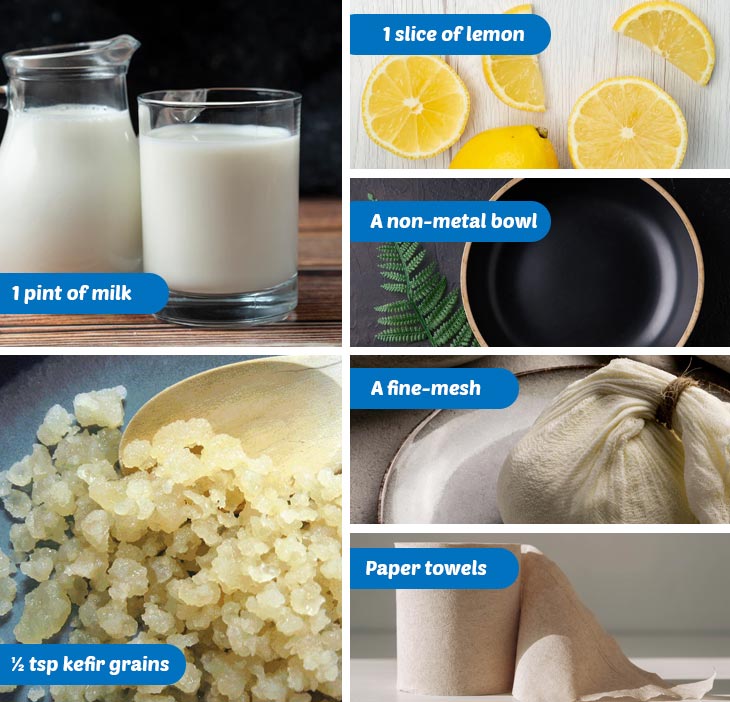
You will need:

  • 1 pint of milk of your choice
  • ½ tsp kefir grains
  • 1 slice of lemon or 1 drop of lemon oil (optional)
  • A fine-mesh non-metal strainer 
  • A non-metal bowl
  • Paper towels or coffee filters (or a clip-top jar)

Step 1

Add the milk and kefir grains to a jar. Cover the jar with paper towels or coffee filters and secure them with a rubber band. This will help prevent bugs and dust from getting into your kefir. If you’re using a clip-top jar, you will just need to close the lid without using any paper towels or coffee filters.

Step 2

Put the jar in a warm and dark place. The temperature should be 65-85°F (18-29°C). Leave the mixture to ferment for 18-24 hours. It’s easy to tell when your kefir has already fermented. The mixture will be thicker and smell of fermented food. If there is yellowish liquid that has separated from everything else, that’s OK. It just means that next time you will need to either use more milk or reduce the fermentation time.

Step 3

Place a strainer over a bowl. It’s important to use non-metal items because metal can negatively impact the quality and taste of kefir. If you don’t have a non-metal strainer or its mesh is not fine enough, you can put a thin kitchen towel inside. 

Pour your kefir mixture into the strainer while stirring it with a non-metal spoon, gently pushing it through the mesh. When all the liquid appears in the bowl, you will be left with kefir grains in your strainer. Just add them to another pint of milk and you can start the fermentation process all over again.

Step 4

It’s time to consume your homemade kefir! Drink it plain or add lemon slices or lemon oil for some additional freshness. You can play around with mint and sweeteners as well. Adjust the kefir to your taste without any worries. 

Homemade kefir will stay fresh in the fridge for 7-10 days. If you somehow manage to store your kefir for longer, there is no need to throw it away. Use it as a base for fluffy pancakes or cake batter!

An alternative method

While kefir doesn’t need as much warmth as, say, yogurt to ferment, it can be tricky to keep it at the required temperature during the winter and summer. Also, not everyone might like the fermentation smell passing through the paper towels or coffee filters you used to cover the jar. 

A milk pasteurizer will automatically keep the mixture within the required temperature range while also protecting it from any dust or bugs. You can also use this machine to make yogurt and other fermented dairy products. And of course, it’s irreplaceable for properly pasteurizing fresh milk. As you might know, all fermented dairy foods require you to use pasteurized milk, as any foreign bacteria might spoil the process or be harmful to you. So if you want to make fresh milk safe without killing all the nutrients it contains by boiling it, a milk pasteurizer is a must-have for your kitchen.
how to make yogurt in a milk pasteurizer

Learn how to make yogurt in a milk pasteurizer at home: https://milkyday.com/blog/2018/07/18/how-to-make-yogurt-in-a-pasteurizer/

You can check out all the milk pasteurizers we offer to find the one that fits your needs. If you need any help with choosing one, we are always ready to assist you. Just drop us a line!

We hope you will enjoy your homemade kefir and it brings you numerous health benefits!

If you Like it, Share it :)

Tuesday, September 20, 2022

PLANT-BASED VS. ANIMAL-DERIVED MILK: HEALTH BENEFITS

Humanity is used to the idea of consuming animal-derived milk and dairy. We’ve been enjoying it since 8,000-10,000 BC. It’s been a cornerstone of our diets for ages. We value dairy for all the health benefits it brings, from filling us with energy to helping us build strong bones, develop muscles, improve our gut health and more. Milk boosts our immune system and works as an anti-inflammatory remedy and a probiotic.

Milk is still a very important part of the diet of people around the world—especially in poorer countries since it is a valuable source of calories and can help prevent issues in malnourished children. Many of us also just appreciate the taste of dairy products.

With that said, plant-based milk and dairy have become overwhelmingly popular lately. Today, cafes are expected to offer a range of plant-based milks for you to put in your coffee. And the amount of dairy products made of plant-based milk has increased significantly. In many places, it’s possible to find ice cream, fermented dairy, cheeses and other products made of plant-based milk.

In this article, we will try to figure out if plant-based milk can replace animal-derived milk in terms of health benefits.

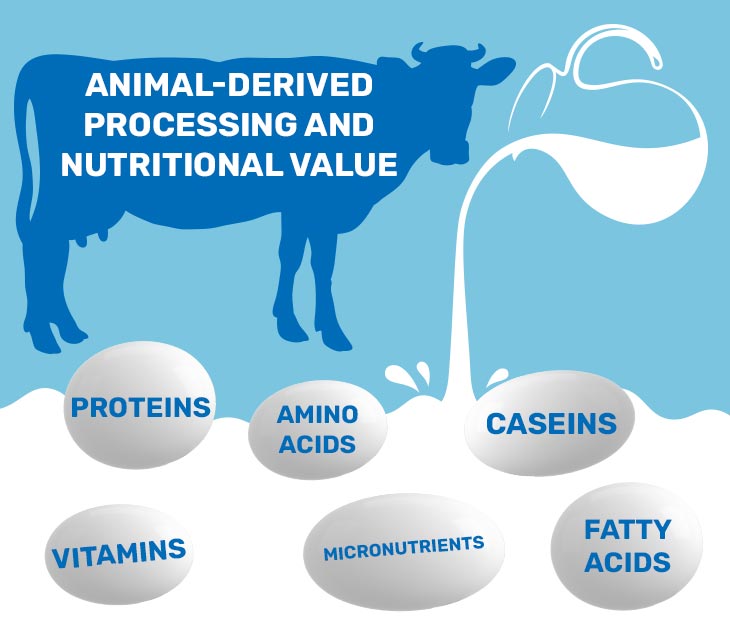
Rich in caseins, proteins, amino acids, fatty acids and numerous vitamins and micronutrients

Animal-derived milk—processing and nutritional value

The value of animal milk is hard to overestimate. It’s clearly beneficial and it’s considered to be important to consume for a good reason. This product is rich in proteins, amino acids, fatty acids and numerous vitamins and micronutrients. We’ve recently conducted extensive research on all the health benefits and nutritional value of animal-derived milk. You can check it out here.

But there is another side of milk. When unpasteurized, it can cause health issues due to the harmful microorganisms it might contain. That’s why it’s mandatory in most countries to pasteurize milk gathered for sale. Small farms must pasteurize their dairy too—even if they’re selling it to just a couple of people. However, many people who gather milk for their own use avoid this step (usually because they believe that pasteurization makes milk less beneficial for their health and worsens its taste).

Here are our thoughts on whether pasteurized milk is better or worse than raw milk:

While that might be true, it largely depends on the method of pasteurization. The best one is Ultra-High Temperature (UHT) pasteurization. It requires heating milk to 135-150°C for just a few seconds. This method allows you to preserve as many nutrients and vitamins as possible and doesn’t change the milk’s taste. 

It’s easy to pasteurize milk at home with a pasteurizer. You can also use this machine to make fermented dairy products! Check out our range of pasteurizers if you want to get one for your kitchen. And if you have any issues with choosing the most suitable one, you can always reach out to us.

https://milkyday.com/products/milk-pasteurizers

Why do people switch to plant-based milk?

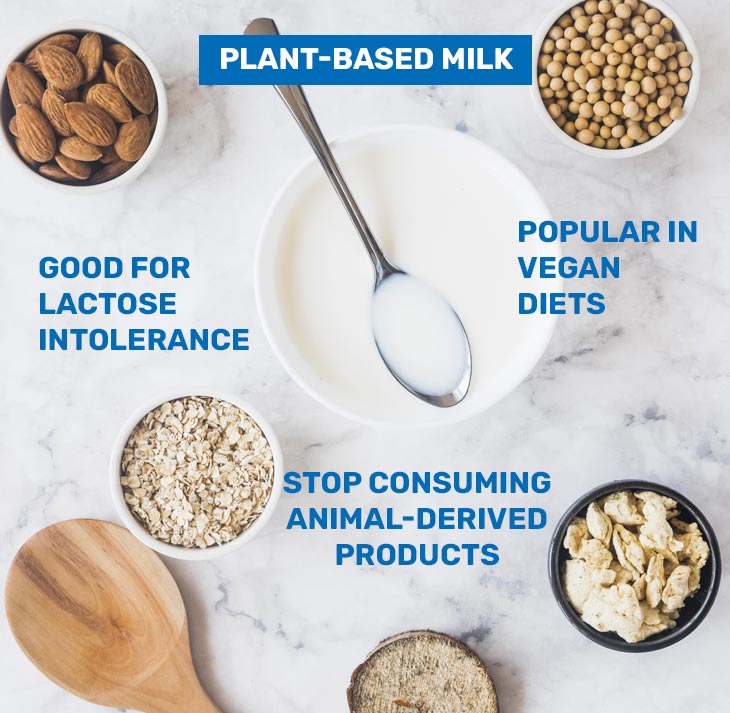
plant-based milk can also bring many health benefits.

As we learn more about all the benefits of animal-derived milk, a few questions arise: Why has plant-based milk become so popular? Why do people choose it instead of animal-derived milk? The simple answer is that plant-based milk can also bring many health benefits.

But there are other reasons why people switch to such milk. First of all, they might want to stop consuming animal-derived products altogether and go vegan for their own reasons. Secondly, some might simply like the taste of plant-based milk better. 

Another reason would be lactose intolerance. People who are allergic to lactose (sugar that is found in milk) experience many unpleasant symptoms when consuming animal-derived dairy. That’s why they turn to plant-based alternatives. However, there are so many options for lactose-free animal-derived dairy that you don’t necessarily have to give up the taste and texture of traditional dairy.

Benefits of plant-based milk

Lastly, with vegetarian and vegan diets becoming so popular, plant-based milk has become trendy as well. As a result, some people switch to these drinks with the sole goal of following something that is considered to be in vogue. 

Benefits of plant-based milk

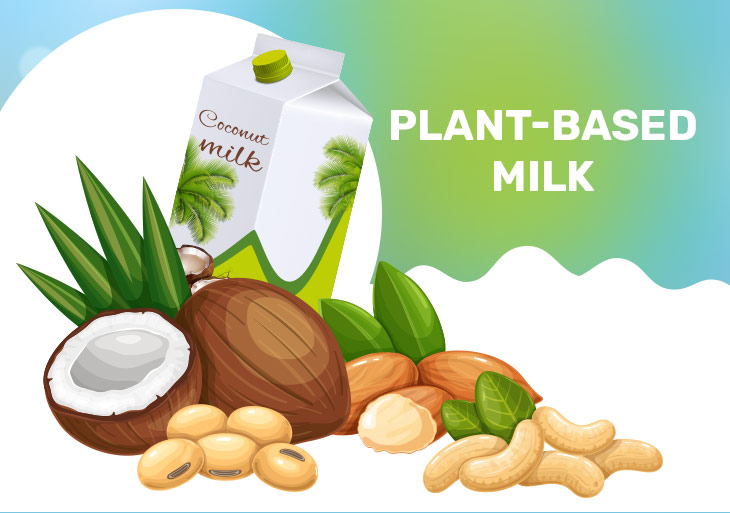
Plant-based milk can be divided into five types:

  • Cereal-based
  • Legume-based
  • Nut-based
  • Seed-based
  • Pseudocereal-based

Obviously, the health benefits of each type of plant-based milk come from the products each milk alternative is made of. For legumes, the benefits are that they’re rich in carbs, proteins, fiber, vitamins and minerals. Chickpeas are full of fibers, monosaccharides, disaccharides and oligosaccharides. Soy contains a lot of carbs, proteins, lipids, fatty acids and amino acids.

Dairy innovation

Seeds contain animal-like proteins (when heated, enzymatically treated or presented with acids, they behave like those found in animal-derived milk). Pumpkin seeds have a lot of lipids, protein and carbs. Flaxseed is rich in fatty acids. Often, seed-based milk is made of sesame seeds, but it’s not a very advantageous animal milk alternative, as sesame seeds lose quite a lot of health benefits when processed to become plant-based milk. When fermented with lactic acid β-glucosidase, though, sesame milk gains quite a strong antioxidant effect. That’s why it’s best to use this drink for making fermented dairy alternatives.

Cereal milk is quite popular too. Oats are high in fiber, vitamin E, β-glucan and polyunsaturated fatty acids. They also work well as a probiotic. Moreover, they contain flavonoids, carotenoids, phenolic acids and other bioactive phytochemicals. Rice is low in protein but high in nutrients. When fermented, it contains a lot of calcium, iron and magnesium, and works as a probiotic.

Nut milk is perhaps the most popular option. Almonds contain a lot of monounsaturated fatty acids, protein, fiber, manganese, vitamin E, antioxidants and more, which makes this milk alternative the healthiest plant-based milk. It’s also considered to be the best-tasting plant-based milk. Coconut milk can increase high-density lipoprotein, thus contributing to lowering cholesterol levels. It’s also a great alternative to animal-derived milk when it comes to making dairy products or cooking dishes that should contain dairy.

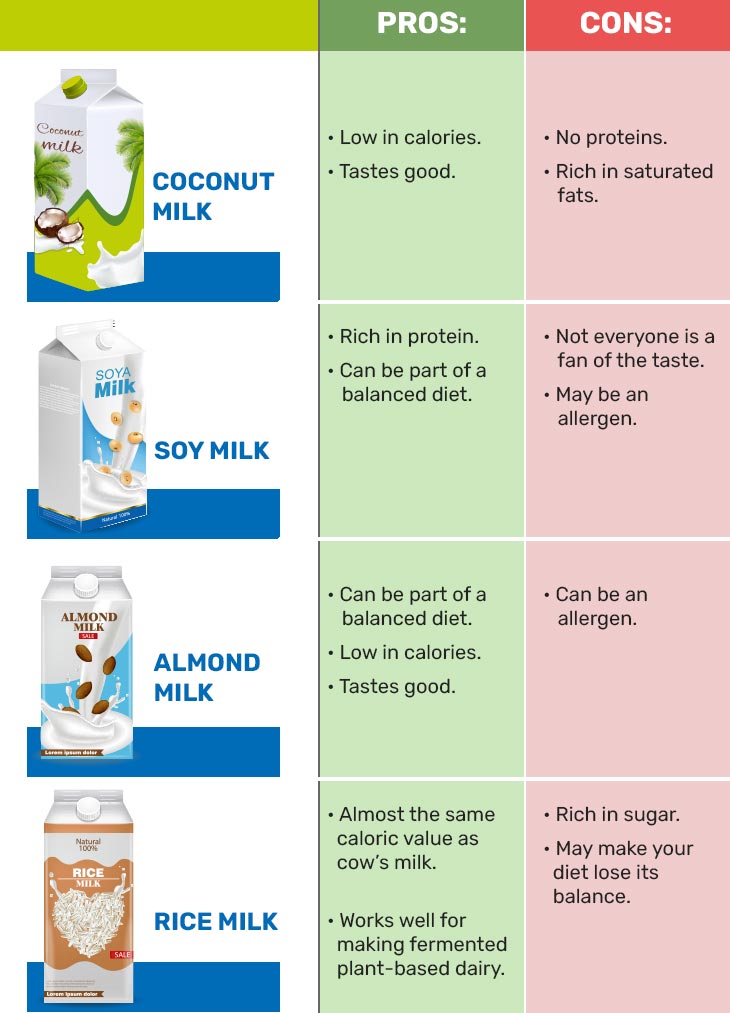
Let’s highlight some important facts about plant-based milk and animal-derived milk (we’re using cow’s milk as an example of animal milk):

compare some plant-based milks to animal-derived milk

Coconut milk

Pros:

  • Low in calories.
  • Tastes good.

Cons:

  • No proteins.
  • Rich in saturated fats.

Soy milk

Pros:

  • Rich in protein.
  • Can be part of a balanced diet.

Cons:

  • Not everyone is a fan of the taste.
  • May be an allergen.

Almond milk

Pros:

  • Can be part of a balanced diet.
  • Low in calories.
  • Tastes good.

Cons:

  • Can be an allergen.

Rice milk

Pros:

  • Almost the same caloric value as cow’s milk.
  • Works well for making fermented plant-based dairy.

Cons:

  • Rich in sugar.
  • May make your diet lose its balance.

https://milkyday.com/planner

Plant-based milk concerns

The main concern is that industrial plant-based milks often contain quite a few undesirable ingredients such as preservatives, thickeners and sweeteners. They might cause issues for your digestive system. Pesticides and other things plants are often presented with might become a health hazard as plant-based milk is made. All that dangerous stuff will appear in your milk alternative. The best approach, in our opinion, is to make plant-based milk at home from ingredients that were checked for any harmful elements.

Also, remember that vegan milk is low in proteins, calcium and vitamin D. So if you decide to replace animal-derived milk with it, make sure to get enough of those micro and macronutrients from other foods or supplements.

The best plant-based milk for coffee

Now, let’s talk about the fun part: the taste. While everyone has their own favorite when it comes to flavor, plant-based milk hits differently when mixed with coffee in terms of both taste and texture. Also, different vegan milks behave differently when heated and introduced to the acidity of coffee.

Soy milk

Its taste is quite neutral, which is a good thing when it comes to adding it to your cup of coffee. It offers similar performance to animal-derived milk when heated. But it might curdle when presented with the acidity or the temperature of the coffee.

Almond milk

Its nutty and bitter taste can be a good addition to coffee. Almond milk adds a nice extra flavor, but due to the lower protein content, it’s quite watery. It can also split when added to coffee.

Coconut milk

This milk alternative is the best one in terms of texture. It’s creamy and dense, so it makes a good base for froth and foam. However, it’s quite sweet. That’s why those who love the acidic and bitter taste of coffee might not like adding coconut milk to their drink. Also, the bubbly foam of coconut milk fades quicker than that of animal-derived milk.

Oat milk

Taste-wise, this is the best partner for coffee thanks to its wheaty notes. It’s also rather thick and creamy, so it makes a good foam and stretches well. Unfortunately, it might curdle when combined with coffee.

Cashew milk

This milk alternative is quite expensive because of the priciness of cashew nuts. However, it is very similar to cow’s milk when it comes to creaminess. The nutty flavor complements the coffee quite deliciously, but it’s rather sweet, so if you love a bitter cup of coffee, cashew milk is not for you. The foam it creates is very bubbly and fades quickly while also having a “bubble bath” texture that many might find unpleasant.

Rice milk

It has a neutral taste that is good for not spoiling your favorite coffee. But rice milk is also quite watery, so if you’re craving an Americano with milk, add this alternative to espresso. This plant-based milk also performs poorly if you want to make some foam with it.

Final thoughts

Everyone should decide for themselves whether they want to stick to animal-derived milk or switch to vegan alternatives. It all comes down to your preferences in terms of diet and flavor. Plant-based milk can offer quite a lot of health benefits, but it all depends on the way a producer processes all those legumes, nuts, seeds or cereal.

As adamant lovers of homemade products, we want to encourage you to make your own plant-based milk at home—especially since it’s rather easy to make!


Monday, September 19, 2022

Electric butter churn australia

 What is a BUTTER CHURN stir?

Margarine agitating machine or, in like manner language, spread beat definition is basic. This is gadget that makes spread from cream, separating it into margarine and buttermilk. First spread beats were made of wood and worked the hard way. Presently you can find these machines made of metal, plastic and glass, and you can work them by power, also.


How does a spread stir function?

Pretty much, every cutting edge spread agitating machine has a similar guideline of activity. You want to add a cream into compartment where the oars will begin to mix it. In this brief video you can perceive how electric spread stir Smooth FJ 10 (115V) works, here is the connection to a similar model


What amount of time does it require to stir spread?

The agitating system requires 25-30 minutes.

What sorts of margarine might I at any point make with spread stirring machine?

The quantity of sorts of spread is restricted simply by your creative mind. For instance, Scratch Power from Australia makes Salted spread, Unsalted margarine, Garlic margarine, Honey spread, Truffle spread and Chocolate margarine (which is delivered at Easter). Coincidentally, Scratch utilizes our electric spread agitate Smooth FJ 32 (230V). Here is the connection to a similar model for 110V/60Hz power supply.


Do you have little margarine beat that I can use at home?


Indeed, a few models we have are reduced and you can utilize them even on the table top in your kitchen. Thus, assuming you are searching for home margarine agitate, we might want to suggest you one of the following models:

Electric spread stir Engine Sich MBE-6 (230V). Assuming that you utilize 115V/60Hz power provider, you can utilize it with voltage converter.

Electric spread agitate Smooth FJ 10 (115V) or a similar model for 230/50Hz power provider;

Hand wrench spread agitate Smooth FJ 10H.


What is the maximal butterfat content I can arrive at utilizing margarine stirring machine?


The maximal fat substance in margarine that was arrived at by our clients is 86.5%. Perhaps somebody arrived at much more significant level of fat however we have barely any insight into this.


How much margarine might I at any point get from my milk?


With our spread agitating machines you can get approx. 4% of margarine from your milk. It truly intends that from 100 kg of milk you can get around 4 kg of margarine.


How might I utilize the buttermilk I get after spread making process?


Buttermilk is a scrumptious item without anyone else, yet you can blend it in with various products of the soil to make it shockingly better. Numerous baked good recipes require buttermilk as one of fixings.


Could I at any point make margarine without spread agitating machine?


Indeed, you can. Assuming you will make some modest quantity of margarine and you don't want to do that step by step, the normal kitchen blender will fit well. Or on the other hand you can be more imaginative as Brian Johnston from the US and endlessly make your custom made spread agitate. He made his own spread creator from his drill press and large paint mixing paddle from the neighborhood home improvement shop.


What sort of cream the margarine stir can process?

You can utilize the cream produced using milk of cow, goat and sheep.


How might I get a cream?

You can get a cream from milk utilizing one of cream separators we offer at Smooth Day. You can likewise gather a cream when it floats up on the milk surface yet that technique won't be so much successful, particularly in the event that you have goat or sheep milk. For this situation, when You don't utilize the cream separator, - be prepared to leave half of the cream in the milk and to gather less fat cream than you could.

Visit: https://milkyday.com/products/butter-churns


Tuesday, September 13, 2022

CAN DAIRY HELP YOU FEEL LESS STRESSED?


CAN DAIRY HELP YOU FEEL LESS STRESSED?

It seems like an entity responsible for what’s happening to the Earth and humanity messed things up and completed a 10-year plan within a couple of years by mistake. All the events happening over the last few years are overwhelming by themselves. And piling up over all the struggles we already have to deal with, these events create even bigger stress for us. It’s fairly difficult to stay calm while trying to sort out our daily issues, keeping up with the speed of life and everything that is happening in the world and impacting us.

The arguably worst thing is that we can’t really do much to change all the things for better. So at Milky Day, we prefer to take a stoic stance and try to see all the bad events as something that just happens and that we have to go through. But when we see that there are things we can change for the better — we, by all means, do that. 

One of the things we can change is the way we respond to stress. While all the psychological tricks such as taking bad stuff that’s happening as an inevitable part of life work, we also seek ways to make our bodies more stress-resistant. After all, our nervous system is quite a physical part of our bodies, and while it creates non-physical things like thoughts and emotions, the fact that it’s a physical part makes us believe that we can impact it with physical things.

Ice cream always makes us feel good! Make some at home and savor that creamy texture: https://milkyday.com/blog/2021/07/22/how-to-make-homemade-ice-cream-from-milk/

There are a lot of medications that help relieve stress. However, being loyal to everything natural, we try to turn to natural remedies. It’s proven that diet can impact the way we handle stress. And in the case of dealing with negative things, diet plays quite a significant role.

In this article, we want to figure out whether adding dairy to our diets can make us calmer and more resilient. We’ve already done our research on all the health benefits of milk, so the mental part seems to be the logical next step.

The connection between nutrition and stress exists

The first thing you might think of when trying to come up with foods and drinks that soothe might be some chamomile or mint tea. If you spend a bit more time in the tea aisle in a supermarket, you will definitely find herbal blends designed for calmness and better sleep. But the link between foods, drinks, and mental health doesn’t end there.

Research shows that protein can help fight depression and anxiety. Frankly, if you think of it, it doesn’t come as a surprise, considering that protein is the main building block in our bodies. A diet full of protein doesn’t just give us more energy but also helps our nervous system deal with all the challenges we face.

Another thing that impacts our mental health is the health of our gut. It’s a well-known fact that an unhealthy gut can make us more anxious, stressed, and depressed — and vice versa. Medicine knows a lot of examples of when gut issues were caused by the psychological condition of a patient — and when the psychological issues were caused by gut issues. So in addition to increasing our protein intake, we should take care of our gut health if we want to be really stress-proof.

A healthy breakfast guarantees a good day. Here’s how to start your morning with something truly great: https://milkyday.com/blog/2019/03/14/how-to-reinvent-a-healthy-breakfast-with-dairy-processors/

How does dairy impact our mental health?

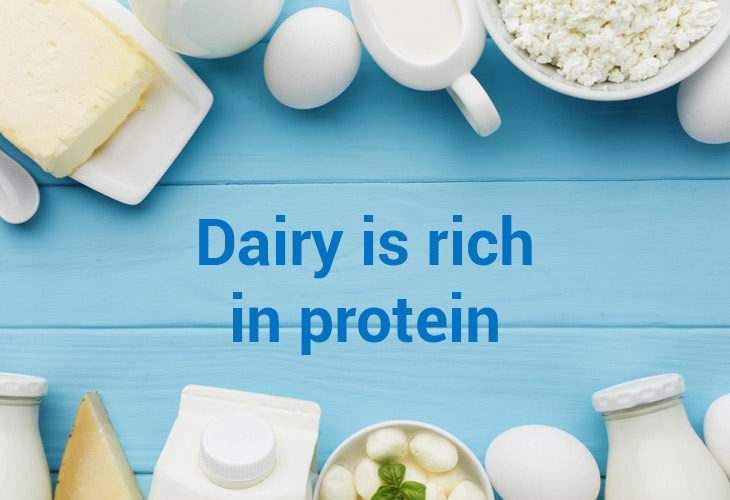
First of all, dairy is rich in protein. And as we’ve already mentioned, protein is quite a good remedy for our stress-ridden minds. By increasing our intake of dairy, we will inevitably increase the protein intake thus helping our bodies to be stronger and our minds to become more resilient. After eating protein, we can notice our mood improving — and that protein being tasty makes the effect even more pronounced. Since dairy is usually delicious, it’s able to hit both the protein and taste targets.

Also, fermented dairy is known for its benefits to the digestive system. It works as a probiotic, helps fight harmful bacteria, and saturates the gut with good bacteria. By just drinking a cup of kefir or eating a cup of yogurt daily, you will improve the health of your gut significantly.

Free Farm Developing Guide

You might think that the mental health benefits of milk end just there, and you will be wrong. Probiotics dairy contains are proven to help people to relieve anxiety and depression symptoms. Also, milk contains phospholipids that are integral for keeping our brains healthy boosting our focus, concentration, and mental energy in general. They also can help to reduce the negative effects of stress and help us stay positive despite any bad things that might happen in our lives.

Not to mention all the other micronutrients and vitamins milk contains. They help our bodies to be healthier and stronger — it’s crucial for dealing with stress because health issues definitely don’t help us stay positive and resilient.

Making foods from scratch is also a good way to unwind. Here’s how to make yogurt at home: https://milkyday.com/blog/2018/08/10/how-to-make-yogurt-at-home/

Finally, dairy is a great help for improving our physical shape as it helps us build muscles faster and recover from workouts. That’s another great benefit because studies show that regular physical activity helps us stay mentally healthy. So enjoy your favorite dairy and let all the steam out while working those muscles!

But what if I’m lactose intolerant?

Well, that’s not really an issue today with all the lactose-free products available on the market. You can find lactose-free anything — from milk and yogurt to cheeses and fermented dairy. And if you can’t find a lactose-free version of your favorite dairy, you can always take lactase tablets before eating milk-based products to help your body digest lactose correctly and avoid all the nasty symptoms of lactose intolerance.

Milk and dairy products are an integral part of our diets for a good reason. They help us to stay both physically and mentally healthy. And let’s face it — they taste so good. Delicious and healthy foods can lift our mood and help us recover from stress. Since dairy is just the right example of such food, we can’t really think of a better alternative.

So let yourself indulge in your favorite dairy and enjoy all the benefits it brings!

Tuesday, May 24, 2022

How to Make Butter at Home - Butter Churning Machine - Milky Day

Even a tiny amount of butter can make any dish much tastier. That’s why in French cuisine it is used literally in every recipe. Usually, a store-bought dairy is rarely high quality. So it’s a good idea to try to make butter at home. Especially since this is a very simple thing to do. Everything you need for it is heavy whipping cream and something to whip it.


There are two ways of making butter: you can use a mixer (or blender) or a butter churn. Both options are good, but using a butter churn you wouldn’t need to worry about separating butter from the buttermilk. Also, an electric churn makes the whole process so effortless that you will fall in love with making butter at home.

Making Butter with a Churn

A butter churn usually has a buttermilk outlet. So all you need to do is to:

  • Pour whipping cream into the churn. The manufacturer will declare the minimum and maximum amount of cream that can be processed in the machine.
  • If you use an electric butter churn, turn it on and let it work for about 20 minutes. Again, the manufacturer will declare how much time is needed. If your butter churn is manual, you will need to work with it for 20-30 minutes.

And that’s it. The process of making butter at home is unbelievably easy, especially with the use of a butter churn. This machine also provides a better output from the cream than a mixer or a blender.

To make your butter taste better you can add just a dash of salt to it or any other ingredients like herbs, garlic, or even chocolate.

Making butter with a mixer or a blender
It’s preferable to use a blender since it makes the process less messy – you can just put the lid on so all splatters will stay inside.

  1. First, pour whipping cream into a blender or a bowl if you use a mixer. Turn your blender (or mixer) on medium-high and wait until the cream becomes whipped cream.
  2. Continue churning it and you will see how it gets thicker and the buttermilk separates from the cream. It means that you are on your way to a homemade butter!
  3. Then the mixture will become more liquid and will swirl around the blades. At this moment the butterfat and the buttermilk are completely separated.
  4. Now carefully pour out the buttermilk. Try to pour out as much of it as possible.
  5. Prepare a bowl with cold or even ice water.
  6. Scrape the butter there and start squeezing and kneading it to get rid of the leftover buttermilk.
  7. Continue doing it and changing the water occasionally until the water remains clean.
  8. Dry the chunk of butter with a towel.

Congratulations! You’ve made butter. Again, you can salt it or add some other spices or ingredients to it.

Wednesday, May 11, 2022

DAIRY INNOVATION TRENDS 2022 FOR SMALL AND MEDIUM-SIZED FARMS

 Every year, a new development impacts the dairy industry. This year is no exception. There are plenty of new trends that can allow us to gain a better understanding of what our next move should be to bring customers exactly what they need. 

However, many of these trends are quite useless for small and medium-sized farms. So we decided to pick out only the most suitable trends for you to save your time and effort.

Sustainability

The main trend is dictated by the eco-friendly movement that’s been going on for years now. Small and medium-sized farms are already quite sustainable because they don’t have huge factories or herds that cause a negative impact on the environment. But there is always room for improvement.

Research from 2020 shows that 67% of consumers care about the health of our planet, and they prefer producers that have the same outlook. We can be sure that this number has only grown since then. Therefore, it’s vital to analyze the way you manage your farm and adjust it to the expectations of consumers.

51% of U.S. consumers care about animal welfare and wish to support farms that provide their animals with good conditions. So that would be a good place to start your journey toward sustainability. You can take a look at the way your kettle is handled and see if you can make any changes to make it less stressed and happier. Find inspiration from all those funny videos of cows scratching their backs on special brushes and playing with toys in a field. 

By the way, if you film your kettle having fun, it could be some nice social media content to promote your farm.

Thoughtful waste disposal, planting cover crops, protecting water and soil, and other ways to reduce your carbon footprint could also represent steps toward an even greener farm. 


Cognitive and mental health

The COVID-19 pandemic wreaked havoc on many people’s mental health. With more free time on our hands, we contemplated how to improve it. While it might not be the most obvious solution, dairy can have a positive impact on our mental health. Numerous studies show that more protein in our diet helps us be less anxious and depressed. Dairy is rich in protein. Also, milk contains the amino acid tryptophan that helps us sleep better, thus allowing us to feel more rested and improving our mental state.

It’s a good idea to market your dairy from this perspective since people keep looking for ways to improve their cognitive abilities and mental health. And we might see an increased demand for the main dairy foods because of this trend.

Learn from the experience of other farmers! Read this story about a small dairy farm in Norway to find new ideas for your workflow: https://milkyday.com/blog/2019/10/15/dairy-farm-from-norway-litlvea-gard/.


Physical health

Who doesn’t want to be healthy? Stress, fast food and the fast pace of life, amplified by the fact that people have less time and energy for exercise, impact our health negatively. Dairy is one of the best solutions for strengthening our bones, improving gut health and digestion, keeping our cardiovascular system in a good shape and much more. You can read about all the health benefits of dairy in one of our previous articles.

By raising awareness of the health benefits of dairy, small and medium-sized farms can attract more local consumers who are seeking ways to improve their wellbeing. If you aren’t selling yogurt and other fermented dairies yet, you should think about doing that, as these foods have even more health benefits. It’s easy to create fermented dairy using suitable bacteria and a milk pasteurizer. 

Check out our range of milk pasteurizers to find the one that fits the volume of dairy you produce. If you’re struggling to make the right choice, just drop us a line and we will help you out! https://milkyday.com/products/milk-pasteurizers

Packaging

This trend of dairy farming in the U.S. refers to the sustainability movement. Consumers want the packaging of their products to be more eco-friendly and, in the best-case scenario, reusable. The top dairy producers have to come up with something new to cater to this requirement because it’s not easy for them to offer reusable packaging. But small and medium-sized farms have a simple solution: good old glass jars. 

In all likelihood, you are already using them as packaging for your dairy products. You can also encourage your customers to bring the jars back to you so that you can clean them properly and reuse them. To assure them that this is safe, you can tell them in detail about the cleaning process and even show them how it works. Reusable packaging is a great way to sell more dairy in 2022.

Thinking about adding more machines to your farm? Check out our guide on milk processing equipment for small and medium-sized farms: https://milkyday.com/blog/2020/08/24/milk-processing-equipment-for-small-scale-dairy-farm/

Digitalization

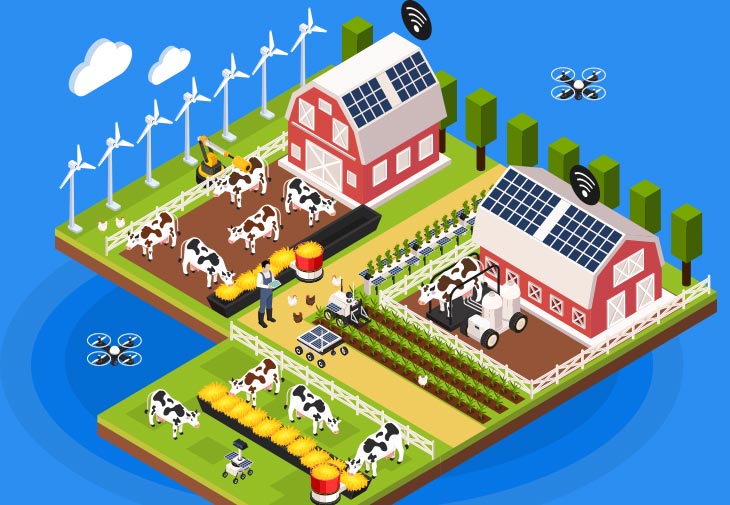
This trend is huge in every industry—not only for milk farms in the U.S. Businesses around the world are doing their best to digitalize their processes in order to make them more efficient and better market their products. While implementing this tendency in a small or medium-sized dairy farm can be tricky, there are digital solutions that can ease your work.

From robotic milking to AI predictions and digital-based cattle management, technology can simplify the processes on your farm. That is precisely what it was created for: to take some of the load off our shoulders. Try searching for some solutions you could implement on your farm that would make your everyday routine easier for you as well as reduce the costs of your processes.

These are trends that are affecting the dairy industry in 2022. Some of them might be not new to you, as they’re influenced by tendencies that already existed before. And some may seem too difficult to implement into your workflow. However, something being a trend doesn’t mean you absolutely have to try it. On the other hand, it never hurts to find new ways to improve things both in terms of the work you need to do and the revenue you bring in. 

So look at this list of trends as tips and inspiration for upgrading your dairy farm and getting more customers.