Monday, February 20, 2023

PROCESS USED TO SEPARATE CREAM FROM MILK - MILKY DAY

 A milk or cream separator is a gadget that eliminates cream from entire milk. Subsequently, the entire milk is partitioned into cream and skim milk after division.


Cream and skim milk have various densities and in this way they will generally get isolated under the effect of gravity. You can test it yourself: Forget about cow's milk for 24 hours and you will perceive the way cream accumulates at the top.


SO HOW DOES A Radiating MILK SEPARATOR Function?


It speeds up the milk's division by utilizing radial power. Separator working rule is as per the following:


A diffusive milk separator machine has cone like circles that turn in a bowl (drum) at a speed of 6,000 to 10,000 cycles each moment, contingent upon the model.


At the point when entire milk gets inside the bowl, the outward power runs it through the openings of the plates.


The milk's fat globules go to the focal point of the drum and the skim milk goes to its external edge since it's heavier. That is the manner by which cream extraction occurs.


These machines come in various sizes so you can get the one appropriate for the volume of milk you need to work with. We offer milk separators for little to medium ranches as well as home use so you can appreciate skimmed milk and cream at home.


Any plate stack separator works along these lines. Whether it's a little model for home use or a modern model for a major dairy, the guideline is as yet unchanged.


Fundamental elements of milk fat separator that value to check out.

Effectiveness: A great diffusive milk separator machine ought to leave somewhere in the range of 0.01% and 0.05% of the butterfat in skim milk — that's what something like.


Limit: A separator's ability is the amount of milk it can handle in one hour or less.


Power supply: Separators can be controlled by power or worked manually. Crossover forms likewise exist.


Become familiar with How to pick a cream separator? 7 significant things assuming you are searching for one of them to utilize.


Different variables that impact milk division

Milk temperature: The ideal milk division temperature is 35-40 degrees Celsius. Warming milk at a temperature over 45 degrees Celsius is not suggested.


Measure of butterfat in the milk: More butterfat in the milk implies more butterfat in the cream after division. The greatest degree of butterfat you can reach with a milk separator is around 35-40%.


Milk quality: Little separators don't have a self-cleaning bowl like the large modern rotators do. So the bowl should be cleaned physically every 30-an hour and a half to eliminate butterfat, ooze and side matter. The specific season of constant detachment relies for the most part upon the nature of the isolated milk.


Our recommendation: Utilizing two bowls is conceivable. You can shift back and forth between them without intruding on the milk centrifugation process. While you clean one bowl, another is working.


Factors that don't impact milk division

Crude versus purified: The most common way of making cream from crude milk doesn't vary from the cycle when the milk is sanitized.


Cow versus goat: has a milder microstructure as a result of its normally more modest fat globules (in examination with cow milk). For this reason goat's cream ascends a lot more slow than cow's cream. Nonetheless, the two sorts of milk separate similarly well with a plate bowl rotator.


Other helpful things a milk separator can do


Normalize milk: Normalization is the course of fat substance guideline in milk. A separator can do this.

Little separators have a managing screw in the bowl. This screw decides the fat substance in the cream.

To get the fat substance in milk normalized, clients of little axis machines need to return a cream to the skim milk. This training is normal in cheddar making, where creation requires milk with the suitable fat substance.

Enormous rotators as a rule have a manual or programmed normalizing framework that controls fat substance in a split second.


Explain milk: Explanation is the method involved with eliminating unfamiliar matter and soil from milk. The explanation cycle is more productive than filtration. Albeit diffusive milk separators and divergent clarifiers are not similar machines, they work on a similar standard. That is the reason there can be some soil, grass other matter still in the bowl after partition.

Eliminate microbes and spores from milk (modern separators just): Intensity safe spores and microorganisms have a higher thickness than milk, so there are exceptional rotators that eliminate them during the division cycle, it calls bactofugation. The microscopic organisms and spores go to the external edge of the bowl, where they will be released.


To sum up, on the off chance that you are searching for a straightforward method for getting cream for home use, a kitchen container will be the right answer for you. However, on the off chance that you run a dairy and mean to isolate or normalize your milk consistently — even on a small size level — a radiating separator is what you really want.


Investigate our scope of cream separators assuming you are on the lookout for one. You will track down some excellent and dependable models.

Thursday, January 12, 2023

How to make condensed milk at home - Milky Bar

 For many people, condensed milk is a taste of childhood. But some might not even know what this is. If you’re from the latter batch, let us give you some insight into this dairy product. Condensed milk is creamy sweet goodness with a bit of a caramel taste that you just want to have a spoonful after a spoonful of until you’re finished with all the condensed milk you have. Seriously, it’s so good you just will fail to stop yourself from eating it. 

For your homemade condensed milk, all the ingredients you need, as we have mentioned above, are milk and sugar. You can use any kind of sugar or replace it at all with another sweetener such as maple syrup, agave, or honey.

So, for the quantities of ingredients, you will need:

  • 2 cups (or 450 ml) of milk. You can use any milk, even plant-based ones. The percentage of fat doesn’t matter as well.
  • ⅔ cups (or 142 grams) of sugar. As we said, you can use any sugar.

And that’s it! Now let’s get to the cooking part.

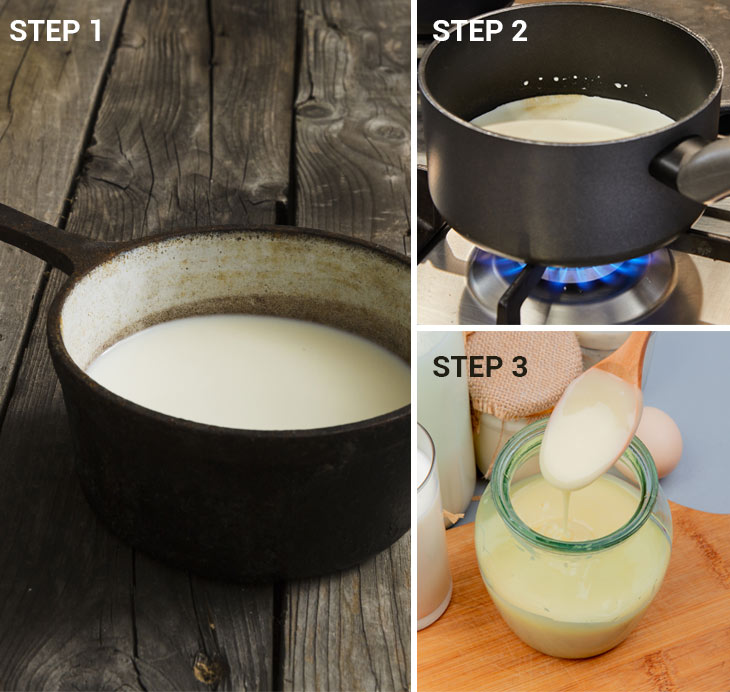
Step 1

Use a heavy-bottomed saucepan to prevent milk from burning. Heat milk and sugar on low heat and stir until all sugar is completely dissolved. Make sure you stir well because otherwise, you will end up with clumps.

Step 2

Keep the mixture on low heat making sure its temperature doesn’t go above 122°F (50°C) until it has reduced approximately by half and got a slightly darker color. The consistency should be thick and creamy.

Step 3

When you have reached the desired consistency, take the mixture away from the heat and pour it into a jar. Let your condensed milk cool down completely before putting it into the fridge.

And that’s it! Now you have your very own homemade condensed milk. You can store it in an airtight jar in the fridge for about a week. And you can freeze it if you want to keep it fresh for about 3 months.

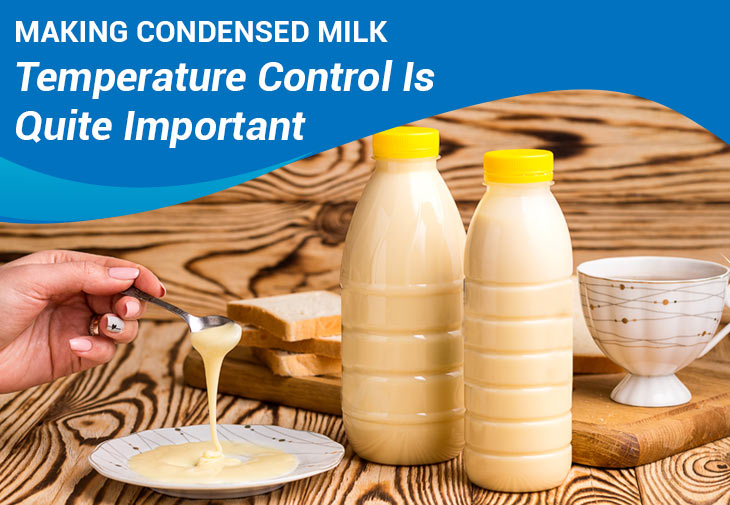
While the process is simple, temperature control is quite important when you’re making condensed milk. That’s why we prefer to make this dairy product using a milk pasteurizer. It’s a machine usually used to pasteurize milk. But you can choose a specific setting to make a pasteurizer to keep your future condensed milk at the required temperature.

In our shop, you can find different pasteurizers designed for home and farm use. You can pick the one that suits your needs. And if you have any difficulties with choosing the option that’s right for you, you can simply drop us a line and we will help you out!

Wednesday, October 19, 2022

DAIRY INNOVATION TRENDS 2022 FOR SMALL AND MEDIUM-SIZED FARMS - MILKY DAY

 Dairy innovation

DAIRY INNOVATION TRENDS 2022 FOR SMALL AND MEDIUM-SIZED FARMS

Every year, a new development impacts the dairy industry. This year is no exception. There are plenty of new trends that can allow us to gain a better understanding of what our next move should be to bring customers exactly what they need. 

However, many of these trends are quite useless for small and medium-sized farms. So we decided to pick out only the most suitable trends for you to save your time and effort.

dairy eco-friendly movement

Sustainability

The main trend is dictated by the eco-friendly movement that’s been going on for years now. Small and medium-sized farms are already quite sustainable because they don’t have huge factories or herds that cause a negative impact on the environment. But there is always room for improvement.

Research from 2020 shows that 67% of consumers care about the health of our planet, and they prefer producers that have the same outlook. We can be sure that this number has only grown since then. Therefore, it’s vital to analyze the way you manage your farm and adjust it to the expectations of consumers.

51% of U.S. consumers care about animal welfare and wish to support farms that provide their animals with good conditions. So that would be a good place to start your journey toward sustainability. You can take a look at the way your kettle is handled and see if you can make any changes to make it less stressed and happier. Find inspiration from all those funny videos of cows scratching their backs on special brushes and playing with toys in a field. 

By the way, if you film your kettle having fun, it could be some nice social media content to promote your farm.

Thoughtful waste disposal, planting cover crops, protecting water and soil, and other ways to reduce your carbon footprint could also represent steps toward an even greener farm. 

dairy for mental health

Cognitive and mental health

The COVID-19 pandemic wreaked havoc on many people’s mental health. With more free time on our hands, we contemplated how to improve it. While it might not be the most obvious solution, dairy can have a positive impact on our mental health. Numerous studies show that more protein in our diet helps us be less anxious and depressed. Dairy is rich in protein. Also, milk contains the amino acid tryptophan that helps us sleep better, thus allowing us to feel more rested and improving our mental state.

It’s a good idea to market your dairy from this perspective since people keep looking for ways to improve their cognitive abilities and mental health. And we might see an increased demand for the main dairy foods because of this trend.

Learn from the experience of other farmers! Read this story about a small dairy farm in Norway to find new ideas for your workflow: https://milkyday.com/blog/2019/10/15/dairy-farm-from-norway-litlvea-gard/.

dairy for physical health

Physical health

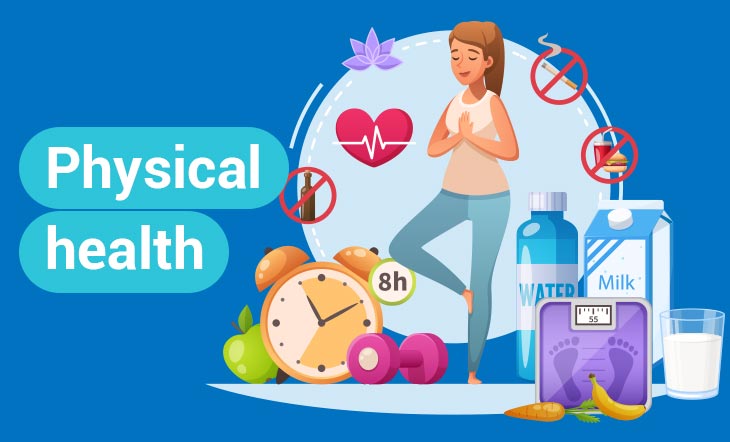
Who doesn’t want to be healthy? Stress, fast food and the fast pace of life, amplified by the fact that people have less time and energy for exercise, impact our health negatively. Dairy is one of the best solutions for strengthening our bones, improving gut health and digestion, keeping our cardiovascular system in a good shape and much more. You can read about all the health benefits of dairy in one of our previous articles.

By raising awareness of the health benefits of dairy, small and medium-sized farms can attract more local consumers who are seeking ways to improve their wellbeing. If you aren’t selling yogurt and other fermented dairies yet, you should think about doing that, as these foods have even more health benefits. It’s easy to create fermented dairy using suitable bacteria and a milk pasteurizer

Check out our range of milk pasteurizers to find the one that fits the volume of dairy you produce. If you’re struggling to make the right choice, just drop us a line and we will help you out! https://milkyday.com/products/milk-pasteurizers

dairy products packaging

Packaging

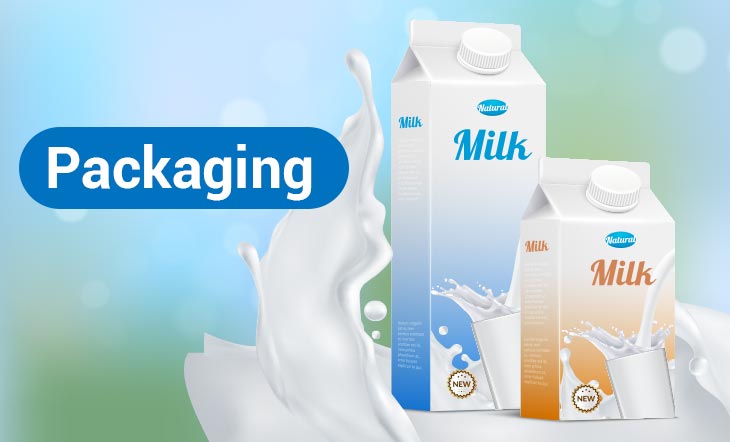
This trend of dairy farming in the U.S. refers to the sustainability movement. Consumers want the packaging of their products to be more eco-friendly and, in the best-case scenario, reusable. The top dairy producers have to come up with something new to cater to this requirement because it’s not easy for them to offer reusable packaging. But small and medium-sized farms have a simple solution: good old glass jars. 

In all likelihood, you are already using them as packaging for your dairy products. You can also encourage your customers to bring the jars back to you so that you can clean them properly and reuse them. To assure them that this is safe, you can tell them in detail about the cleaning process and even show them how it works. Reusable packaging is a great way to sell more dairy in 2022.

Thinking about adding more machines to your farm? Check out our guide on milk processing equipment for small and medium-sized farms: https://milkyday.com/blog/2020/08/24/milk-processing-equipment-for-small-scale-dairy-farm/

dairy business digitization

Digitalization

This trend is huge in every industry—not only for milk farms in the U.S. Businesses around the world are doing their best to digitalize their processes in order to make them more efficient and better market their products. While implementing this tendency in a small or medium-sized dairy farm can be tricky, there are digital solutions that can ease your work.

From robotic milking to AI predictions and digital-based cattle management, technology can simplify the processes on your farm. That is precisely what it was created for: to take some of the load off our shoulders. Try searching for some solutions you could implement on your farm that would make your everyday routine easier for you as well as reduce the costs of your processes.

“Are You Ready for Running a Small Dairy Business?” Checklist

These are trends that are affecting the dairy industry in 2022. Some of them might be not new to you, as they’re influenced by tendencies that already existed before. And some may seem too difficult to implement into your workflow. However, something being a trend doesn’t mean you absolutely have to try it. On the other hand, it never hurts to find new ways to improve things both in terms of the work you need to do and the revenue you bring in. 

So look at this list of trends as tips and inspiration for upgrading your dairy farm and getting more customers.

Tuesday, October 11, 2022

RECIPE: HOMEMADE MILK SOAP + ITS BENEFITS FOR SKIN

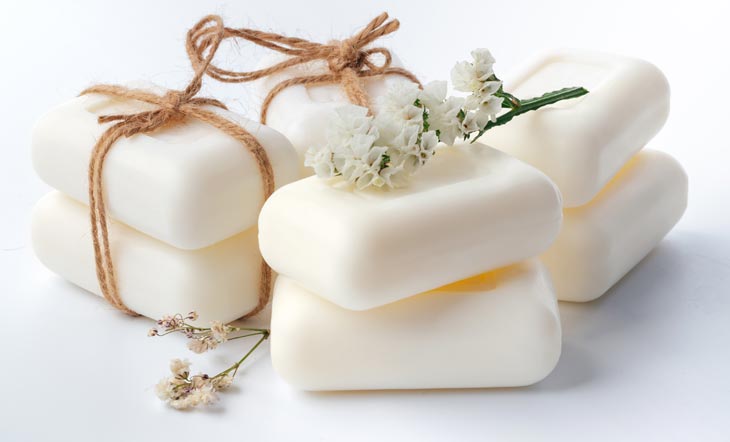
 Homemade milk soap

RECIPE: HOMEMADE MILK SOAP + ITS BENEFITS FOR SKIN

We all know how good milk and dairy products are for our health and skin. We even have an article about all their benefits (you can read it here). So why not take your relationship with milk to the next level and start using it directly on your skin? Humans have used it to improve their skin for ages. One famous example is Cleopatra’s milk bath.

That’s why we’ve decided to share this simple and foolproof milk soap recipe that doesn’t require any special skill or much time to make. Enjoy!

How to make homemade milk soap

How to make your own milk soap

Here is the list of ingredients you’ll need:

  • 9 oz (or 255 grams) milk — You can use any whole milk, not just from cows.
  • 4.3 oz (or 122 grams) lye (sodium hydroxide) — This is your milk base.
  • optional: 1 1/2 tsp sodium lactate — To help harden the soap.
  • 22 oz (or 624 grams) olive oil — Moisturizes the skin and improves your complexion.
  • 8 oz (or 227 grams) coconut oil — Reduces inflammation.
  • 1 oz (or 28 grams) castor oil — Stimulates the production of collagen.

You can use a different soap base if you prefer. Just find out how much of it you need to use and all the details about its shelf life as well as the way it might react with other ingredients. Soap bases are usually universal and easily interchangeable, so you shouldn’t have any problems with swapping lye for some other soap base.

Step 1

First, you need to freeze the milk so that it has a slushy consistency. The best way to do that is by pouring the milk into ice cube trays for faster freezing. This will protect the sugars in the milk from scorching.

Step 2

Add the lye to the milk bit by bit and begin to thaw it. Don’t rush this step. You want the lye to melt into the milk and get distributed properly. The milk might become yellow or get a funky smell during this step. That’s completely normal. Once you’ve added all the lye, stir the mixture from the bottom to ensure that the lye is evenly distributed. Check for particles. If there aren’t any, put the mixture aside.

Step 3

Mix all the oils in a separate bowl or container. Make sure they’re combined very well. If the coconut oil is too solid for this, heat it very briefly just to melt it. All the oils should be at room temperature.

Step 4

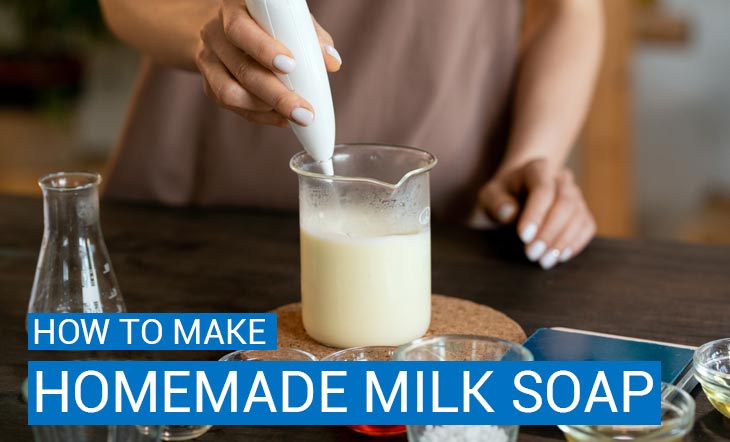
Sodium hydroxide is extremely dangerous, so make sure to use safety gloves, glasses and work under the hood to avoid getting these particles on your skin or in your eyes. Slowly pour the milk and lye mixture into the oil mixture. You can use a hand blender with a whisk tool for this. Just be careful and switch to manual mixing from time to time to prevent the incorporation of air into the mixture. There should be no bubbles in it. Work the mixture very well until the oils are completely incorporated and you can’t see them. At this point, you can also add a couple of drops of your favorite essential oil. Just be careful when it comes to adding more scents to soap because milk has its own distinct smell.

Step 5

All that’s left to do now is to pour the mixture into molds and let it set. There is no need to cure this soap. It will harden by itself. If you want your soap to look whiter, put it in the freezer for 24 hours and then take it out and leave it at room temperature for 24-48 hours. For a browner shade, just leave it out at room temperature for 24 hours after pouring it into the molds.

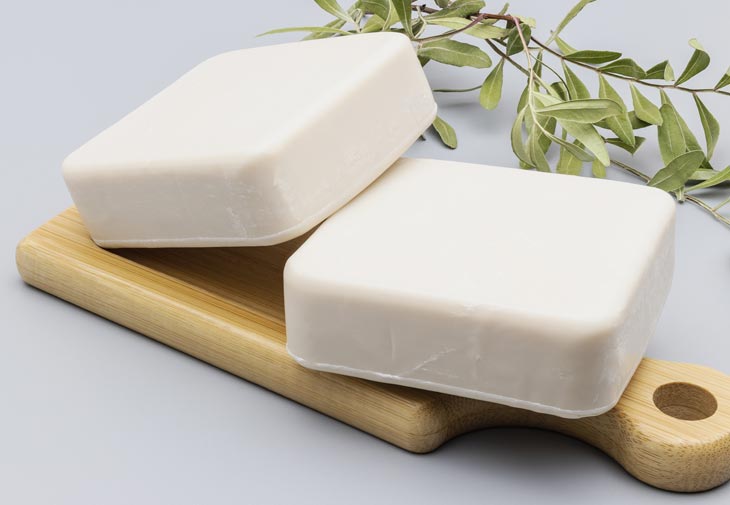
Your homemade milk soap is now ready!

Storing and using homemade soap

Storing and using homemade soap

The soap made by following this recipe will be good for up to two years. You don’t have to worry about it going bad. However, if you added any botanicals or other ingredients that can spoil faster, you should calculate the shelf life of soap based on what you have added. And, yes, you can customize this soap by adding other ingredients! Just be careful with the way ingredients react to each other and don’t add too many oils. If you want to add another oil to our recipe, add a smaller amount of one of the listed oils. Excess oil will make soap too soft.

how to store soap

Store your soap in a dry, cool and dark place wrapped in plastic wrap. You can also put it in a zipper bag or use shrink plastic. Just be careful to not melt the soap while you’re packaging it. If you wrap and store your homemade soap and you haven’t added any ingredients that spoil fast, it might have an even longer shelf life than two years. It might change its color a bit, but it will be good to use nevertheless.

Benefits of milk soap

Benefits of milk soap

Milk soap, whether it’s homemade or store-bought, has many benefits thanks to the milk itself. With that said, when you make the soap at home, you know exactly what’s in it. This might be important if you have sensitive skin.

It’s gentle

It’s gentle

Milk soap is a gentle cleanser, especially if it’s made at home with the recipe we provided above. It doesn’t strip the skin of its natural oils and thus does not damage its protective barrier. The milk and oils in the soap might actually help to strengthen that barrier.

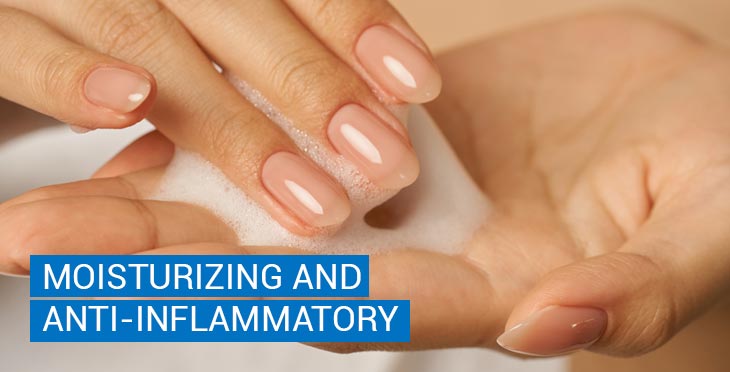
Moisturizing and anti-inflammatory

Moisturizing and anti-inflammatory benefits

Homemade milk soap moisturizes the skin and helps reduce inflammation thanks to the selenium, fatty acids and cholesterol that milk contains. So using it might help with some skin issues. However, you should remember that soap itself is just a cleanser and you need to use other products such as serums and creams to manage any skin problems you experience.

In addition to that, milk contains vitamin A (also known as retinol), which is famous for its anti-aging and brightening effects. 

Milk, along with all the oils added to it to make soap, improves the lipid barrier of the skin and helps keep it moisturized, healthy and resistant to the impact of external factors such as sun and air pollution. Yet, as we’ve already said, soap is just a cleanser. Always use sunscreen when you walk outside during the day. And if you live in an area with highly polluted air, look up some creams that protect the skin from such damage.

Soft exfoliation of milk soap

Soft exfoliation

Milk contains alpha-hydroxy acids (AHAs) such as lactic acid that play the role of exfoliators. AHAs are widely used to treat acne, scars and hyperpigmentation caused either by the sun or by aging. They remove dead skin cells, boost the production of collagen and give the skin a more youthful and better complexion. Keep in mind that you can’t really know how much of these acids are in the milk you’ve used. Also, homemade milk soap can never be as effective as specialty products containing these acids. So you shouldn’t expect any dramatic effects. However, that’s good news as well—especially if you’re going to use your soap daily. Too much exfoliation damages the protective barrier of the skin. For this reason, you might want to avoid overusing your homemade milk soap.

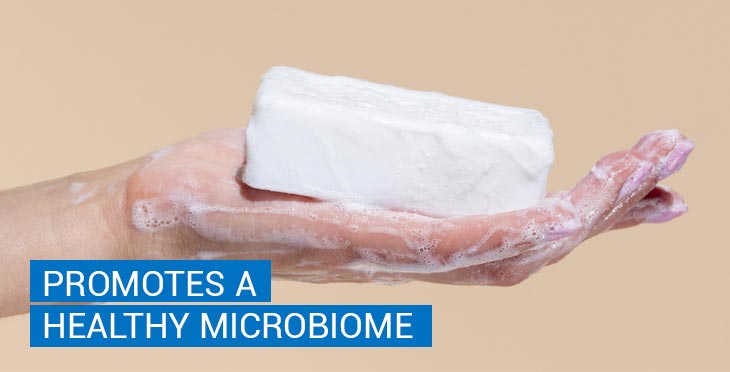
Milk soap promotes a healthy microbiome

Promotes a healthy microbiome

Every living thing has a microbiome (i.e. a world of bacteria). And our skin has one as well. Healthy bacteria help keep our skin healthy. But the environment and our eating habits might disrupt this microbiome. Since milk is the main ingredient of this homemade soap, it can improve the microbiome of your skin, thus making it healthier and more resistant to external factors.

Might help with acne

Might help with acne

One form of acne treatment is thorough cleaning because acne spreads through certain bacteria. This homemade milk soap is a gentle yet effective cleanser that can help stop the growth and spread of this bacteria. It’s important to use gentle cleansers if you struggle with acne because harsh soaps strip the skin of its natural oils. The skin will then try to regain its balance and begin to produce more oils, which will lead to clogged pores and even more acne.

Are you ready for small dairy business?

The AHAs exfoliate the skin, improving the cleansing effect and helping reduce acne while improving the overall condition of the skin. And the moisturizing effect of the milk soap will maintain the moisture balance of your skin, helping it to heal from acne. Again, the soap itself is not a remedy and you need to use other products to get rid of acne effectively. 

We hope you will enjoy this homemade milk soap! Along with eating healthy and using other products, it can help you get that healthy and glowing skin we all dream of.

Tuesday, October 4, 2022

How Dairy Products Impact Your Health and Beauty

 The debate on whether dairy is good or bad for you never seems to end. Well, we’ve also decided to take part in this conversation. There are a lot of different beliefs surrounding this topic. However, many of them aren’t based on some substantial scientific evidence but rather on the personal preferences and health differences of each human being.

In this article, we will highlight all the benefits of dairy as well as the negative impacts it might have on your health and beauty.

Is dairy good or bad?

Is dairy good or bad?

Here’s a quick answer: If you’re not lactose-intolerant, dairy is good for you. Even if you are, though, there is an abundance of lactose-free dairy to be found. You can also get lactase (an enzyme that basically eats lactose sugar) at a pharmacy. Just take it before consuming dairy and you’re good to go.

If you’re one of the lucky people without lactose intolerance, dairy can have a positive impact both on your health and looks. It improves your bone density and gut health. It can strengthen your nails and hair and improve your complexion as well.

Dairy products planner

Of course, everything is only good in moderation. The Dietary Guidelines for Americans encourage people to consume three servings of dairy daily. That’s how much milk you should drink a day. But if you drink more of it, you might encounter negative consequences. So chugging milk without consideration won’t help you become healthier—especially considering that our bodies can only digest so many nutrients and vitamins. The excess will just leave the system naturally. In the worst-case scenario, you might get nutrient and vitamin overdose symptoms.

Now, let’s take a look at all the benefits and possible risks in detail.

Dairy and health

In this section, we will take a look at the health benefits of milk and dairy as well as their drawbacks.

Health benefits of dairy

Health benefits of dairy

Dairy has many benefits. If you were wondering whether milk and cheese have protein, the answer is yes, they do. Quite a lot of it. So if you’re trying to gain muscle without going over your calorie limit, dairy is a great option. There are just 90-150 calories in a cup of milk, and you can check the calorie value of your favorite yogurts, cheeses and other dairy products for more information.

Another good thing about dairy is the high amount of vitamins and micronutrients it contains. The most significant ones are vitamins B12, B7, B2, magnesium and, of course, calcium. The latter is very important for keeping our bodies running well and improving bone density. It’s especially vital for women to consume enough calcium, as they keep building their bones up until menopause. So it’s good to keep that bone-building going in order to be ready for menopause. Pregnancy can have a negative impact on bone density too.

Dairy can also reduce the risk of heart disease and stroke

Dairy can also reduce the risk of heart disease and stroke thanks to the fatty acids it contains. However, if you already have issues with your cardiovascular system, you should talk to your doctor about your dairy intake.

Casein and the whey proteins found in dairy improve the mineral absorption of our bodies and serve as anti-inflammatory and anti-oxidative remedies. This can benefit both the health and condition of your skin.

Fermented dairy has an even more positive impact on our health thanks to the bacteria it contains. It can help with gut health and improve digestion. Honestly, we’ve tested this on ourselves and can say with confidence that even a cup of good yogurt or kefir makes your gut work much better.

Finally, dairy helps to repair muscle. It benefits post-exercise muscle synthesis and re-hydrates our muscles, thus bringing us more results from our workouts and making that post-workout soreness lighter and faster to go away.

Read our guide to healthy breakfasts with dairy: https://milkyday.com/blog/2019/03/14/how-to-reinvent-a-healthy-breakfast-with-dairy-processors/

Health risks of dairy

We’ve already mentioned that if you have some issues with your cardiovascular system, you should talk to your doctor about whether you should consume dairy and what kinds of it you should focus on. 

One of the biggest issues with milk—especially if you get it from unreliable sources—is that it might be contaminated with hormones, antibiotics and pesticides. Thanks to the latest regulations, dairy producers are now more careful with such things, so the amount of contaminated milk is much lower. However, if you get dairy from a local farm, inform yourself about its approach.

You should be careful with dairy paired with sugar and processed products. When we consume dairy, our bodies begin to break down the protein it contains and turn it into something similar to insulin hormones. Mix that with sugary and processed foods, and you’ll get an even higher level of insulin, as your body will try to deal with the sugar levels. A high level of insulin leads to inflammation that will disrupt your health and affect your skin. That’s why you should be careful with all those fruity yogurts, ice cream and other dairy mixed with sugar.

Here’s how to reduce the amount of sugar in your dairy: https://milkyday.com/blog/2019/02/25/how-to-reduce-the-amount-of-sugar-and-fat-in-frozen-dairy-desserts/

health risk of dairy product

Then there’s lactose intolerance. If you feel unwell after consuming dairy, get bloated and gassy, and your bowel movements become irregular, you might be intolerant to lactose. As we’ve already said, try lactose-free dairy or the lactase enzyme. With that said, not all dairy products will make you feel bad—even if they contain lactose. Many people wonder, “Does yogurt have lactose?” The majority of fermented dairy products do not have large concentrations of the lactose. Greek yogurt, for example, contains very little lactose if made correctly. But you can’t really be sure if it was made correctly.

You can make your own fermented dairy at home using lactose-eating bacteria and our milk pasteurizers. This way, you will know for sure your dairy is safe to consume. Check out our range of milk pasteurizers and pick the one that fits your needs. If you’re struggling to identify which one is right for you, just drop us a line and we will help you.

Can you gain weight by consuming dairy?

Dairy is fairly low in calories, so if you consume it in moderation, you won’t gain weight just from that. Remember that we gain weight when we continuously consume more calories than we spend. If dairy becomes a part of your healthy diet that stays within your calorie needs, you will not gain weight. Moreover, you might even lose a bit, as dairy improves digestion and thus has a positive impact on your metabolism.

dairy for beauty

Dairy and beauty

We’ve mentioned that the vitamins and micronutrients in dairy improve the condition of our nails and hair. They can have a good impact on our skin as well. While there is a belief that dairy causes acne and skin inflammation, research is still ongoing on this topic. Dairy contains retinol and vitamin D, which are among the most popular anti-aging and anti-inflammatory remedies. Calcium, potassium, chlorides, sodium, magnesium, phosphor and other trace elements in dairy help to speed up cell regeneration, and the vitamins in dairy keep our skin moisturized and improve our complexion.

On the other hand, everyone’s body is different, and you should try staying off dairy for a while if you struggle with skin issues. If it helps, then not consuming dairy is right for you. If it doesn’t, then there is a problem with something else. If it helps, then dairy likely raises your insulin-like growth factor-1. Some studies show that people who struggle with acne tend to have an increased level of this hormone. Keep in mind that you should also be careful with mixing dairy and sugar. Increased levels of insulin can cause inflammation, and sooner or later, that will manifest itself as skin issues.

Interestingly enough, skimmed milk usually causes more skin issues than whole milk. Maybe that’s because of those fatty acids we were talking about in the health section. We have detailed articles about skimmed milk and whether it’s better than full-fat milk.

Dairy is mostly beneficial for both our health and beauty, so enjoy it if you don’t have any issues that come from consuming it.

Tuesday, September 27, 2022

HOMEMADE KEFIR AND ITS BENEFITS - Milky Day

 Do you want to improve your digestion and gut health, make your bones stronger and even lose weight? Then you should add kefir to your daily diet!

Kefir might sound somewhat exotic to you, but we believe you should try to include this drink in your diet—especially if you’re familiar with kombucha or other fermented foods. The taste is quite mild and kefir brings so many health benefits to the table.

what-is-kefir?

What is kefir?

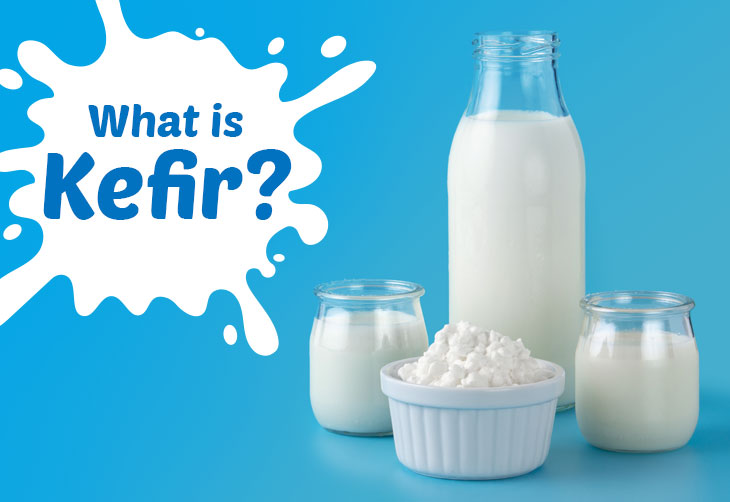
Kefir is a fermented milk drink that originated in North Caucasus. It is very popular in Asia and Eastern Europe. It has a thick, creamy and slightly bubbly fermented texture as well as a mild sour taste. You can drink kefir as is, add your favorite sweetener to it or even use it for cooking pancakes, baking and more!

Craving some ice cream

Craving some ice cream? Make it at home! Here is how: https://milkyday.com/blog/2021/07/22/how-to-make-homemade-ice-cream-from-milk/

Health benefits of kefir

This drink offers many health benefits.

Health benefits of kefir

It contains many nutrients

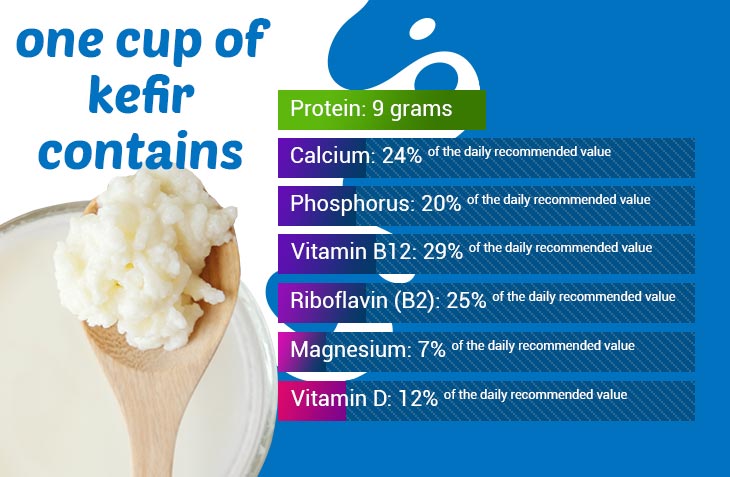
Here are all the nutrients contained in just one cup of kefir:

  • Protein: 9 grams
  • Calcium: 24% of the daily recommended value 
  • Phosphorus: 20% of the daily recommended value
  • Vitamin B12: 29% of the daily recommended value
  • Riboflavin (B2): 25% of the daily recommended value
  • Magnesium: 7% of the daily recommended value
  • Vitamin D: 12% of the daily recommended value

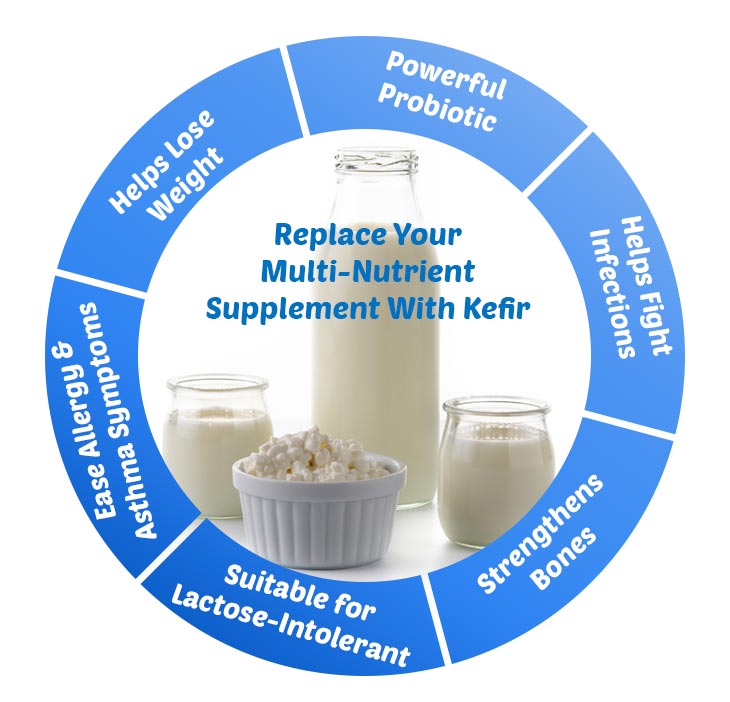
Yes, all this goodness is in just one cup of this drink! You basically can replace your multi-nutrient supplement with kefir.

It’s a powerful probiotic

We’re somewhat used to yogurt being a probiotic, and it is a good one. Kefir just happens to be even more powerful. Kefir grains contain up to 61 strains of bacteria and yeasts. This makes the drink a very rich and diverse source of probiotics—especially compared to other fermented dairy products that usually contain fewer strains and no yeasts. That’s why kefir is so good for your gut health.

Kefir significantly improves digestive function, reduces bloating and even speeds up your metabolism so that your body can process food faster. That’s why doctors in Eastern Europe and Asia often recommend that patients with gut illnesses add kefir to their diet.

Dairy products planner

It helps you fight infections

It’s getting better and better, isn’t it? Kefir is a true superfood that can also help protect against harmful bacteria thanks to the Lactobacillus kefiri probiotic it contains. It can help you fight Salmonella, Helicobacter pylori, E. coli and other harmful bacteria. Also, kefir contains a type of carbohydrate called Kefiran that improves your protection against nasty bacteria.

It strengthens bones and prevents osteoporosis

As a great source of calcium and vitamin K2—the latter helps the body process calcium—kefir is an ideal drink to keep your bones healthy. It improves the quality of bone tissue, thus making your bones denser and stronger. As a result, kefir can make you less prone to fractures.

Thanks to this, kefir also can reduce the risk of osteoporosis (a deterioration of bone tissue that increases the risk of fractures). This illness is a very big concern in Western countries—especially for older women. So it’s great news that a single cup of kefir per day can help prevent bone density issues.

suitable for lactose-intolerant people

It’s suitable for lactose-intolerant people

Thanks to the fermentation process, the lactose sugar that milk contains turns into lactic acid. That’s why people who suffer from lactose intolerance can surprisingly find themselves feeling OK after consuming kefir. 

Of course, bear in mind that the fermentation process doesn’t make kefir a completely lactose-free drink. It just significantly reduces the amount of lactose sugar, which is the cause of lactose-intolerance symptoms. If kefir from cow’s milk still makes you experience discomfort, you can try goat or sheep kefir since milk from these animals contains less lactose sugar than milk from cows. And if the issue still bothers you, it’s always possible to make kefir from plant-based milk.

free-farm-development-guide

It may ease allergy and asthma symptoms

Both asthma and allergies are caused by an inflammatory process. Research shows that kefir can reduce inflammation in the body. Therefore, it might be helpful for people who struggle with allergies and asthma. However, the research is incomplete and we wouldn’t recommend putting too much faith in kefir in this case.

Nevertheless, this dairy drink can definitely become a useful and healthy addition to your diet.

It can help you lose weight

While being highly nutritious, kefir is low in calories. One cup contains about 104 calories, 11.6 grams of carbs and 2-3 grams of fat (depending on the type of milk used to make it). Despite being a low-calorie drink, kefir is incredibly filling too. So if you feel hungry at night and don’t want to binge-eat, a cup of kefir can save the day.

We’ve mentioned that kefir can help speed up your metabolism. Here is a little tip for you: Try adding one teaspoon each of ginger powder and cinnamon per cup of kefir (depending on your tolerance of these spices). Such a drink can greatly boost your metabolism and help you stay fit.

How to make kefir at home

Now, let’s see how you can make this dairy drink at home. The process is fairly straightforward. Frankly, it is quite difficult to mess it up.

How to make kefir at home

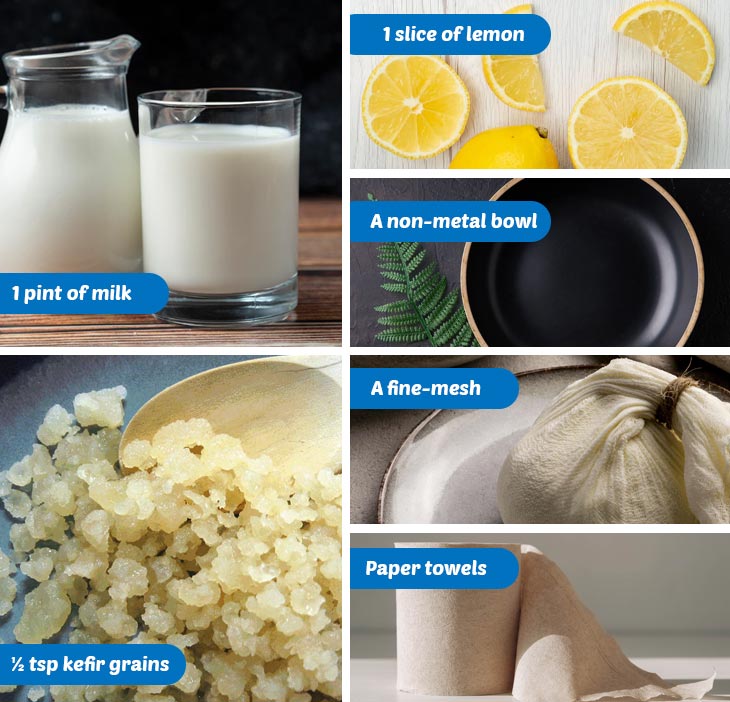
You will need:

  • 1 pint of milk of your choice
  • ½ tsp kefir grains
  • 1 slice of lemon or 1 drop of lemon oil (optional)
  • A fine-mesh non-metal strainer 
  • A non-metal bowl
  • Paper towels or coffee filters (or a clip-top jar)

Step 1

Add the milk and kefir grains to a jar. Cover the jar with paper towels or coffee filters and secure them with a rubber band. This will help prevent bugs and dust from getting into your kefir. If you’re using a clip-top jar, you will just need to close the lid without using any paper towels or coffee filters.

Step 2

Put the jar in a warm and dark place. The temperature should be 65-85°F (18-29°C). Leave the mixture to ferment for 18-24 hours. It’s easy to tell when your kefir has already fermented. The mixture will be thicker and smell of fermented food. If there is yellowish liquid that has separated from everything else, that’s OK. It just means that next time you will need to either use more milk or reduce the fermentation time.

Step 3

Place a strainer over a bowl. It’s important to use non-metal items because metal can negatively impact the quality and taste of kefir. If you don’t have a non-metal strainer or its mesh is not fine enough, you can put a thin kitchen towel inside. 

Pour your kefir mixture into the strainer while stirring it with a non-metal spoon, gently pushing it through the mesh. When all the liquid appears in the bowl, you will be left with kefir grains in your strainer. Just add them to another pint of milk and you can start the fermentation process all over again.

Step 4

It’s time to consume your homemade kefir! Drink it plain or add lemon slices or lemon oil for some additional freshness. You can play around with mint and sweeteners as well. Adjust the kefir to your taste without any worries. 

Homemade kefir will stay fresh in the fridge for 7-10 days. If you somehow manage to store your kefir for longer, there is no need to throw it away. Use it as a base for fluffy pancakes or cake batter!

An alternative method

While kefir doesn’t need as much warmth as, say, yogurt to ferment, it can be tricky to keep it at the required temperature during the winter and summer. Also, not everyone might like the fermentation smell passing through the paper towels or coffee filters you used to cover the jar. 

A milk pasteurizer will automatically keep the mixture within the required temperature range while also protecting it from any dust or bugs. You can also use this machine to make yogurt and other fermented dairy products. And of course, it’s irreplaceable for properly pasteurizing fresh milk. As you might know, all fermented dairy foods require you to use pasteurized milk, as any foreign bacteria might spoil the process or be harmful to you. So if you want to make fresh milk safe without killing all the nutrients it contains by boiling it, a milk pasteurizer is a must-have for your kitchen.

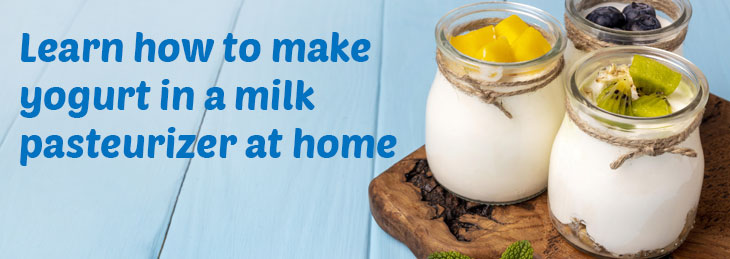
how to make yogurt in a milk pasteurizer

Learn how to make yogurt in a milk pasteurizer at home: https://milkyday.com/blog/2018/07/18/how-to-make-yogurt-in-a-pasteurizer/

You can check out all the milk pasteurizers we offer to find the one that fits your needs. If you need any help with choosing one, we are always ready to assist you. Just drop us a line!

We hope you will enjoy your homemade kefir and it brings you numerous health benefits!

If you Like it, Share it :)